ISO8583 Payments Filter, Notifications, Alerts, Data Warehouse
Real-time Anomalies detection, Notifications and Alerts, analysis and logging
Integrate card payments ISO8583 transactions with Web interfaces, Databases, Mobile
Microservices or standalone server, logging, reporting
TCP/IP to HTTP Web services, or any API CSV, binary files
Common ISO 8583 Transaction Anomalies detected
Anomalies can be broadly categorized into Statistical Deviations (volume/rate) and Fraud/Logic Deviations (content/pattern).
Statistical Deviations (Volume/Rate)
These are changes in the flow of transactions that deviate significantly from a calculated or historical baseline.
Sudden Volume Spike
A sudden, sustained increase in iso8583 transactions being declined (e.g., Response Code $05$, $51$, $54$, $55$, $57$, $59$) from a specific Merchant, Terminal, or Issuer. This is a common indicator of Card Testing Fraud.
Monitoring Action: ISO8583 Response Code (DE 39), Terminal ID (DE 41), Acquirer ID (DE 32)
High System Error Rate
An unusual increase in network/system errors (e.g., Response Codes $91$, $96$) pointing to an issue in a downstream processor, network link, or internal service.
Monitoring Action: ISO8583 Response Code (DE 39), MTI
Low or Zero Volume
A sharp drop in transaction volume, indicating a network outage, system disconnect, or a key component failure (e.g., a critical payment gateway service has stopped).
Monitoring Action: ISO8583 MTI (monitoring for absence of expected messages, like $0800$/$0810$ Echo Tests)
Unusual Transaction Amount
An exceptionally large transaction amount (DE 4) or a series of transactions with a very small, round amount (Card Testing).
Monitoring Action: ISO8583 Transaction Amount (DE 4)
FREE Proof of Concept with all technical support
Velocity Attack
Many transactions using the same card (PAN - DE 2) or same terminal (DE 41) within a very short timeframe.
Monitoring Action: ISO8583 Primary Account Number (DE 2), Terminal ID (DE 41), Transaction Time (DE 7)
Geographic Mismatch
Transactions from the same card or user originating from widely different geographical locations within an impossible travel time.
Monitoring Action: ISO8583 Terminal Location (DE 43) (or derived from Acquirer ID (DE 32))
Processing Code Mismatch
A transaction with an unexpected combination of MTI (message type) and Processing Code (DE 3). For example, an Authorization Request ($0100$) with a Settlement Processing Code.
Monitoring Action: ISO8583 MTI, Processing Code (DE 3)
Mandatory Field Missing
A transaction where a data element that is mandatory for its MTI or Processing Code is missing or improperly formatted (e.g., the PAN is present, but the bitmap indicates its absence).
Monitoring Action: ISO8583 Bitmap, Mandatory Data Elements (DEs) (e.g., DE 2, DE 4, DE 12, DE 41)
How to Check for Anomalies on ISO8583 transactions
The detection system needs to implement rules and baselines based on specific ISO8583 fields.
Establish Baselines (for Statistical Anomalies)
Time-Series Analysis
Track key metrics minute-by-minute, hour-by-hour, and day-by-day.
Metrics
Total $0100$ (Auth Request) Volume, Total $0200$ (Financial Request) Volume, Rate of Response Code $05$ (Do Not Honor), Rate of Response Code $91$ (Issuer Unavailable).
Dynamic Thresholds on ISO8583 transactions
Instead of fixed numbers, calculate a rolling average and standard deviation for each metric (e.g., last 30 minutes, last 24 hours, last 7 days).
Rule Example
Alert if Metric X is $> 3$ Standard Deviations above its 24-hour moving average. This self-adjusts for daily/weekly peak traffic.
Rule-Based Checks on ISO8583 transactions (for Fraud/Logic Anomalies)
ISO8583 Velocity Checks
Rule: For a given Card Number (DE 2), set a counter: Alert if Count > 5 Authorizations in 60 seconds.
Rule: For a given Terminal ID (DE 41), set a counter: Alert if Count > 100 Transactions in 5 minutes.
ISO8583 Format/Logic Checks
Validate the message structure in real-time. Use a schema validation to ensure required fields based on the MTI are present (Bitmap) and that variable-length fields are correctly prefixed with the length indicator.
ISO8583 Response Code Grouping
Track declines by category: "Hard Declines" ($54$, $41$), "Soft Declines" ($05$, $51$), and "System Errors" ($91$, $96$). Alert on unusual spikes in any of these groups for a particular Acquirer (DE 32) or Issuer BIN.
Actions to Be Taken on ISO8583 alerts
The response to an alert depends on the severity and nature of the anomaly detected on ISO8583 transactions.
| Alert Severity | Anomaly Type | Recommended Initial Action | Potential Follow-up/Automation |
|---|---|---|---|
| HIGH | High System Error Rate (e.g., $91$, $96$) | Immediate Pager/SMS Alert to Network Operations/System Team. | Automated traffic re-routing or throttling to the failing entity/link. Open a critical incident ticket. |
| MEDIUM/HIGH | High Decline Rate (e.g., Card Testing) | Email/Dashboard Alert to Fraud/Risk Team. Contact the Acquirer/Merchant. | Automated blocking of the originating Terminal ID (DE 41) or the entire BIN Range if the attack continues after initial alert. |
| MEDIUM | Sudden Volume Spike | Email Alert to Network Operations/Capacity Planning. | Traffic Throttling or applying a temporary rate limit to the source IP/Acquirer to prevent system overload. |
| MEDIUM/HIGH | Velocity Attack (Individual Card) | Real-time Alert to Fraud System/Authorization Host. | Immediate soft-block on the PAN (DE 2) for a short duration (e.g., 30 minutes) or forcing a decline with code $59$ (Suspected Fraud) for subsequent transactions. |
| LOW/MEDIUM | Processing Code Mismatch | Log and Review by Compliance/Switching Team. | Hard-reject the transaction with an appropriate error code ($12$ - Invalid Transaction). |
ISO8583 Logging and Auditing
Every anomaly detected is logged with all relevant ISO 8583 fields (especially MTI, DE 3, DE 39, DE 41, DE 42) and a timestamp for post-incident review.
System Integrity
Alerts related to system errors ($91, 96$) or zero volume always take priority, as they indicate a failure impacting all legitimate traffic.
Detecting System Malfunction Anomalies (Response Codes $91$ & $96$)
These anomalies are typically identified by monitoring the frequency of specific system-related decline codes in the Response Code (DE 39).
Key ISO 8583 Fields to Monitor
| ISO 8583 Field | Data Element (DE) | Relevance to System Malfunction | ||
|---|---|---|---|---|
| Response Code | DE 39 | Most Critical: Codes like $91$ (Issuer/Switch Unavailable) or $96$ (System Malfunction/Halted) are direct indicators of a system failure. | ||
| Message Type | MTI | Helps identify which type of message is failing (e.g., $0110$ Authorization Response vs. $0210$ Financial Response). | ||
| Acquirer ID | DE 32 | Pinpoints the specific acquirer or source that is experiencing the failure or is being blocked by a downstream system. | ||
| Issuer Identification | BIN | First 6 digits of DE 2 - Helps determine if the problem is localized to a specific card issuer system or is widespread. | ||
| Processing Code | DE 3 | Indicates the type of transaction that is failing (e.g., $000000$ for Purchase, $500000$ for ATM Withdrawal). | ||
Anomaly Detection Rules (Operational Thresholds)
Unlike fraud detection, which uses high ratios, system malfunction detection focuses on the absolute count of error codes and the loss of expected messages.
| Anomaly Rule | Description | Trigger Thresholds (Examples) |
|---|---|---|
| High System Error Volume | Checks the raw count of system-related errors (DE 39 = $91$ or $96$) across all traffic. | Alert if Count of $91/96$ codes $> 50$ in a 60-second window across the entire switch. |
| Acquirer-Specific Failure Rate | Checks the failure rate for a single partner/acquirer, indicating a localized issue. | Alert if $> 50\%$ of all responses sent to Acquirer DE 32 contain $91$ or $96$ in a 5-minute window. |
| Issuer/BIN Outage | Checks the failure rate when communicating with a specific card Issuer (identified by the BIN). | Alert if $> 90\%$ of transactions for a specific BIN return $91$ or $96$ in a 1-minute window. |
| Absence of Expected Message (Echo Test) | Monitors for the non-arrival of network management messages, which are typically used for a system "heartbeat." | Alert if no $0800$ Network Management Request (Echo Test) is received or no $0810$ response is sent/received within the expected 15-minute interval.. |
Recommended Alert Actions
The response to a system malfunction must be immediate and prioritize restoring service availability.
Alert Severity: CRITICAL
These are system outages that require immediate Tier 1 support or Network Operations attention.
Notification: Immediate Pager or SMS Alert
Alert to the Network Operations Center (NOC) and System Administrators.
| Alert Scenario | Initial Action | Automated Action / Resolution | ||
|---|---|---|---|---|
| High $91$ (Issuer Unavailable) | NOC immediately attempts to ping or confirm connectivity with the affected downstream Issuer/Switch. | If a secondary/backup link exists, the system should automatically re-route the transactions for that specific Issuer/BIN to the alternate connection. | ||
| High $96$ (System Malfunction) | NOC immediately investigates the local system logs for the component that generated the error. | If the failure is detected in an internal service, the system should attempt to failover to a redundant service instance (e.g., in a clustered environment) and restart the failed component. | ||
| No Echo Test ($0800/0810$ Missing) | NOC initiates an immediate manual Echo Test ($0800$) to the partner in question. | If the connection is confirmed to be down, the system should automatically update the connection status as 'OFFLINE' to prevent further requests from being sent, thus avoiding more $96$ errors. | ||
ISO8583 Message Logging to Data Warehouse for Analysis
Real Time or Near Real Time Log payments messages
Switch transactions and save to SQL, raw ISO8583 messages, flat files
Make real-time statistics, or just save data for later
Easily save transactions to CSV, import to Excel and create graphs
Payments messages metrics and Notifications
- Extract any fields from transactions messages, make counters
- Check on approved payments , declines or parse errors
- Send data to any Database, logging system or just Excel
- Extract and use this valuable data for project decisions
- make graphs and analysis for more accurate high management meetings decisions
Knowledge is power!
Transaction logging for testing phase and test reports. Analyse what has been tested!
Authorization messages logging for errors analysis. Check what your system is processing.
Payments logging for in-depth business analysis and reporting
Be informed before taking important management decisions
Have automatic statistics be available every week, month and year!
Answer business questions
- How many transactions were run yesterday?
- How many were CHIP and PIN and how many magnetic stripe?
- Declined for limits, Insufficient funds or EMV failure?
- How many times was a card used yesterday>
- How many ATM transactions, how many POS and e-commerce?
- How many were declined for fraud?
- How many were recurring scheduled payments?
Detect abnormal situations
- Scripting "sensing" of abnormal situations
- Detect sudden increases in declines
- Detect sudden increase from a specific merchant
- Detect abnormal use of cards
- Detect sudden decrease in transactions
The ISO8583 Logger will listen to your connection, parse and log
ISO8583 messages so you can extract reports.
You can easily
then view you transactions in a text file, or import them from a CSV
file to Excel, so you can process them and extract reports.
With this kind of answers you can plan better, optimize your
configuration, use it to assess granulation for performance testing,
and many other things for business presentations and statistics.
Features of the ISO8583 Payments Notification & Alerts
any payments formats
any connection type
any message standard
scalable multi-threaded
all configurable
Deploy to cloud or local
no installation
unpack and run
platform independent
Run in container or standalone
very simple User Interface
server mode with no-UI
move to local, test mode
high TPS, low impact
small footprint
all memory run
no database required
Analytics
console output
log to files as any message
generate XML, HTML logs
superb HTML reports, graphs
Maintenance
version control configuration
several configuration streams possible
in-house business logic updates
no delivery dependency
Connectivity
files, any encoding, even binary
TCP , Web Services, HTTP
CSV files storage
databases
API, PSD2
Messages
XML, JSON, ISO8583, ISO20022, SWIFT, TLV, CSV, SQL in the box
fully configurable
crazy flexible: insert ISO8583 in XML
crazy powerful: send ISO8583 to file
crazy conversion: ISO8583-XML-SQL
Cryptography
EMV, PIN, MAC, in the box
several cryptogram methods
several PIN block methods
any encryption standard
Incoming transactions from many sources with message conversion
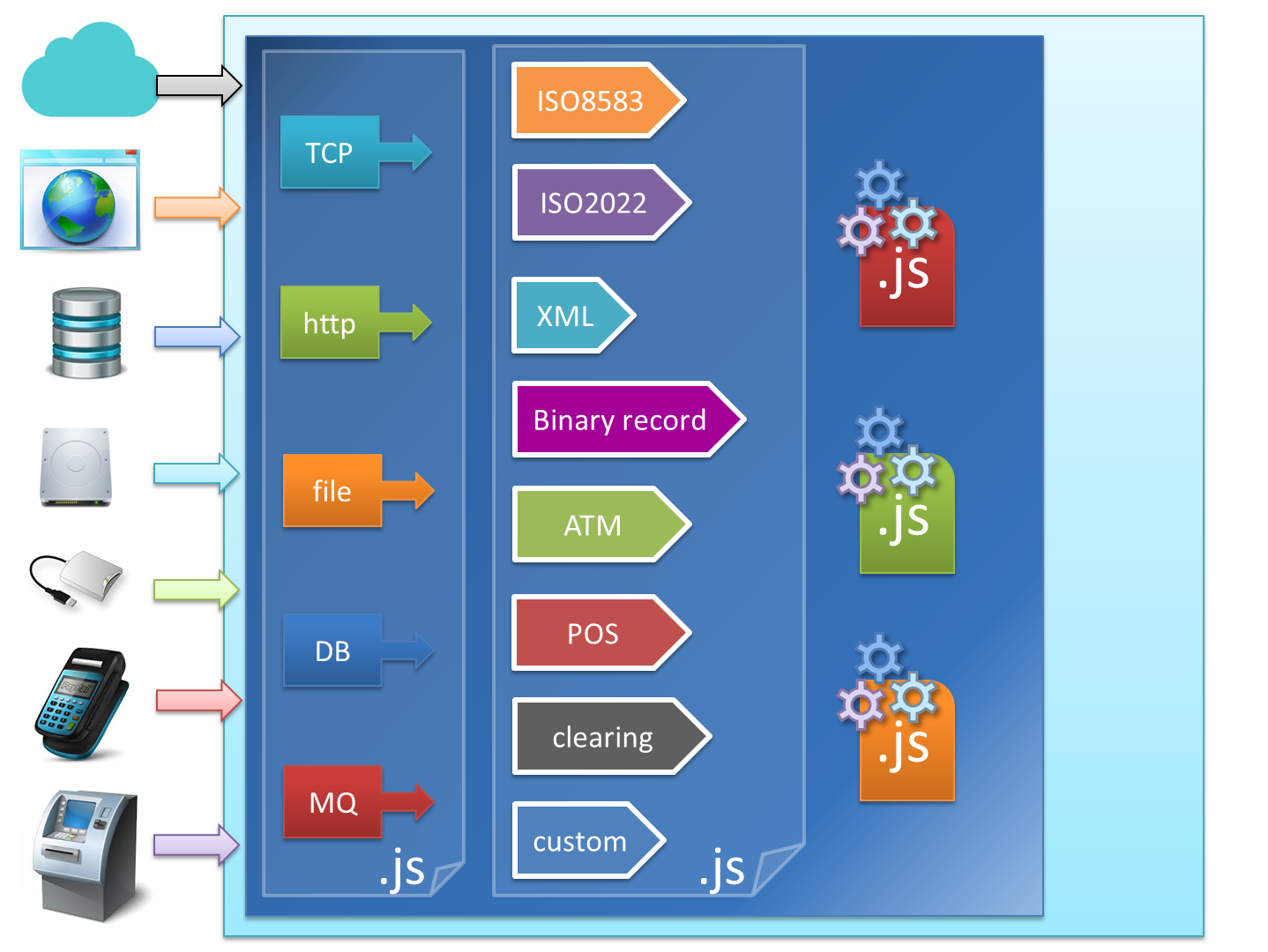
How Payments Notification & Alerts works
On the felt side we have transactions coming in
The connection type is defined in .js files
Each connection is configurable independently
The script engine asks the connection to read data into a message
The connection reads information into a message
Message structures are defined independently from connections
Messages are also defined in .js files
The message is returned to the script engine
The script engine calls scripts to validate, alter information
Additional business logic can be applied via the scritps
We can then convert this information and create an output message
We take the way back and the script engine can send the new message to a connection
The connection will actually send the message out
All components work independently
Recent Articles on Alert
ISO8583 Converter REST-api
Convert ISO8583 to rest-api JSON XML SQL &more
ISO8583 Interface Connector
Integrate ISO8583 card schemes and hosts
ISO20022 SWIFT MT MX Converter
Convert and integrate ISO20022 SWIFT MX with MT , ISO8583
ISO8583 Builder Parser Connector
Most simple solution to build and parse ISO8583 messages
ISO8583 Switch Router
ISO8583 or REST-api Switch Router Bin Amount
Card Payments Authorization
Pre-screen, pre-authorize and Authorize cards and ledger
POS Card Acquirer & Aggregator
Acquiring and Aggregating from POS and other devices
Cards Generator Issuing Host
Generate and export card data for cards issuing and test
ISO8583 Simulator
ISO8583 HISO98 HISO87 simulator
ISO20022 Simulator
ISO20022 & SWIFT simulator
POS Simulator
POS protocols simulator
Mobile Banking Simulator
Mobile Banking Testing Simulator
QR Payments Connector
EMV QR Payments Interface Connector
Micropayments Connector
Micropayments Acquiring Connector & Router
ISO8583 Alerts Notifications
Detect Anomalies, Alerts & Notifications
Clearing & Settlement
Generate Convert Import
Get a free quote, Ask for details
Get help
Read Documentation and Start guides
Online Tools Overview