How to Connect a Modern Microservice to an ISO8583 Payment Network Without Writing a Single Line of Protocol Code
Category: ISO8583 Converter Target reader: CTO, Tech Architect, Payments Consultant
Keywords: ISO8583 REST API integration, ISO8583 JSON converter, connect microservice to card network, ISO8583 without developer, payment integration no code
Your backend speaks JSON. The card network speaks ISO8583. Between those two facts sits what most engineering teams discover too late: a protocol gap that cannot be bridged with a weekend sprint, a smart intern, or a library pulled from GitHub.
This article is about how to close that gap without hiring an ISO8583 specialist, without building a custom translation layer, and without delaying your payment go-live by months.
The Protocol Gap Nobody Warns You About
ISO8583 is the financial messaging standard that sits underneath virtually every card payment on the planet — every swipe, tap, and online checkout that flows through Visa, Mastercard, Amex, or a domestic scheme. It was designed in an era of fixed-width binary messages, bitmap field encoding, and TCP socket connections that stay open and stateful for the lifetime of a session.
Modern microservices are built on the opposite assumptions: JSON or XML payloads, stateless HTTP requests, REST or GraphQL interfaces, and cloud-native infrastructure that scales horizontally.
These two worlds do not naturally talk to each other. ISO8583 is not just a different data format — it is a different communication paradigm. You cannot point an API gateway at it. You cannot write a middleware function in an afternoon. The protocol has bitmaps that indicate which of 128 possible data elements are present in a given message, each with its own length encoding (fixed, LLVAR, LLLVAR), character encoding (ASCII, EBCDIC, BCD, Binary), and scheme-specific interpretation. And that is before you touch message type indicators, network management messages, echo tests, and the keep-alive logic that card schemes require to consider a connection healthy.
The gap is real, and it has swallowed budget and timelines at companies far larger than yours.
What Teams Usually Try First (And Why It Fails)
Option 1: Assign it to a backend engineer. Most backend engineers have never worked with ISO8583. The learning curve from "I understand the spec" to "I can reliably send, receive, parse, and respond to live card scheme messages without dropping connections or corrupting bitmaps" is typically three to six months of full-time work. And once that engineer leaves, so does the knowledge.
Option 2: Find an open source library. There are ISO8583 parsing libraries in Java, Python, and Go. They solve part of the problem — they can pack and unpack message bytes. But a library is not an integration. You still need to write the TCP connection manager, handle the scheme-specific message variants, implement echo and network management logic, map your business data to the correct fields, and manage the operational concerns of keeping a persistent socket alive in production. The library gets you 20% of the way there.
Option 3: Hire a payments consultant or specialist. This works, but it is expensive, slow to start, and leaves you with bespoke code that only the consultant fully understands. When the integration needs to change — and it always does — you are back to depending on a person.
The Better Architecture: A Converter as a Protocol Bridge
The approach that avoids all three failure modes is deploying a dedicated ISO8583 converter between your microservice and the card network. This converter does one job with deep expertise: it accepts structured REST or JSON requests from your system and translates them into valid ISO8583 messages, manages the TCP connection to the scheme, and returns responses back to your system as clean JSON or XML.
The result is that your backend team never touches the protocol at all. From their perspective, they are calling a REST endpoint. The converter handles everything that happens beyond that endpoint: the bitmap, the field encoding, the socket management, the scheme-specific variants, the message type indicators, the reversal flows, the echo tests.
Your team's integration surface becomes a JSON interface with documented fields. That is a problem any competent backend engineer can solve in days, not months.
What neaPay's ISO8583 Converter Actually Does
The neaPay ISO8583 Converter is a deployable component — available on-premise or in your cloud environment — that sits between your application layer and the card network or payment host.
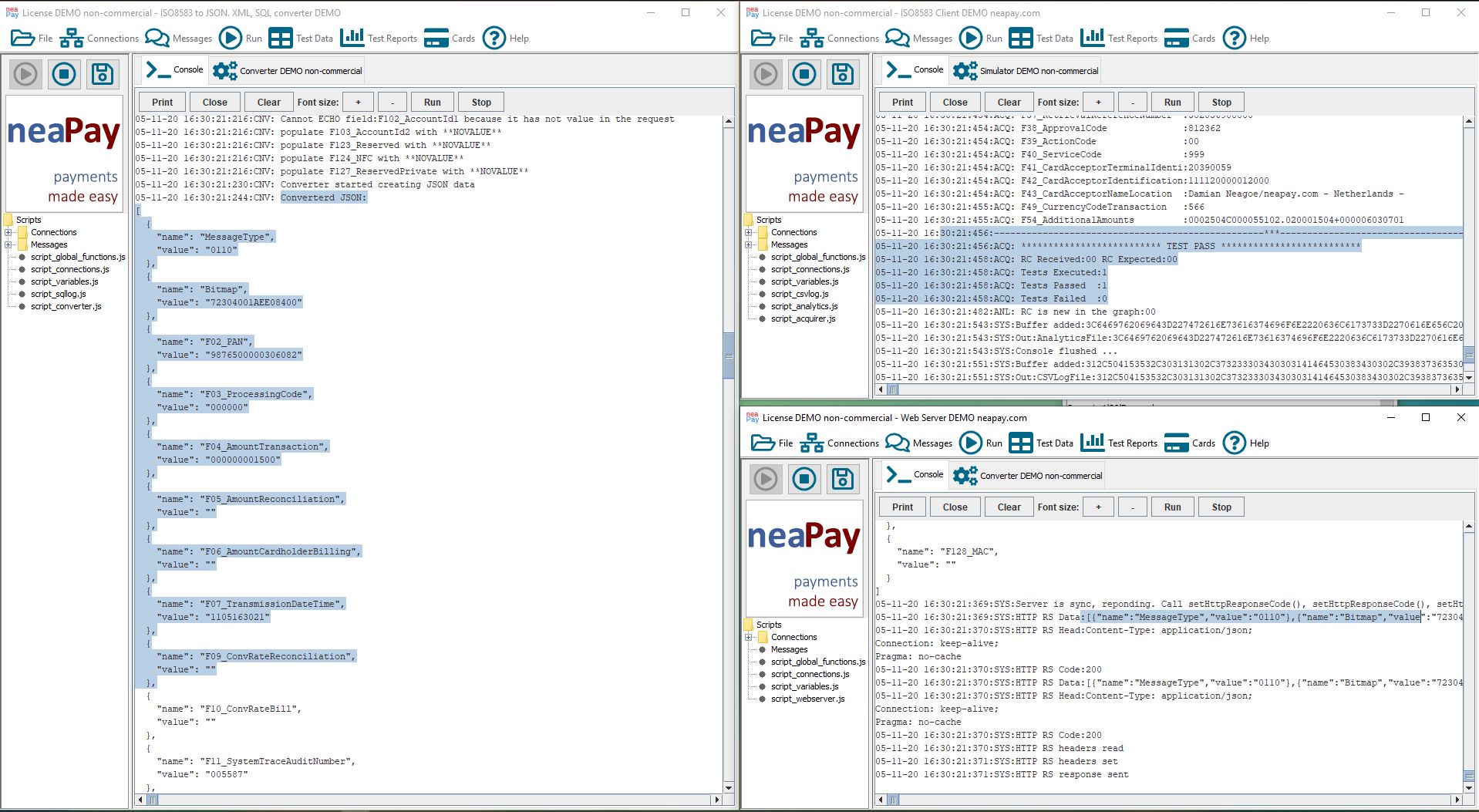
On the inbound side, your microservice sends a standard HTTP POST request with a JSON or XML body describing the transaction: card number, amount, currency, merchant data, terminal ID, and the other fields your scheme requires. You do not need to know which ISO8583 field those values map to. The converter knows.
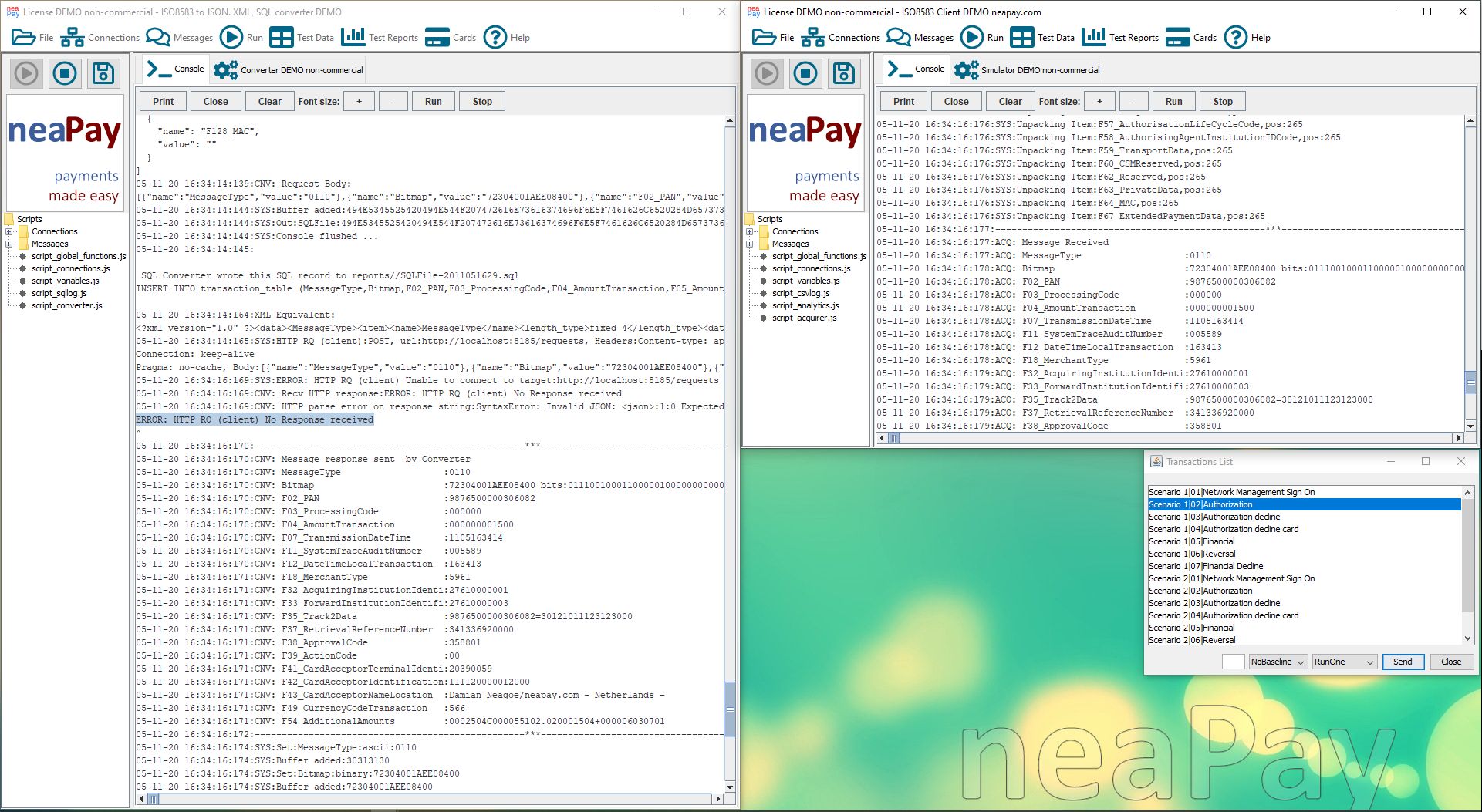
The converter builds a valid ISO8583 message from that input, including the correct bitmap, the right length indicators for each field, and any scheme-specific encoding rules. It sends that message over a persistent TCP connection to the card scheme or acquiring host, manages the response, and returns a clean JSON object to your microservice with the authorization result, response code, and any data elements the scheme returned.
On the configuration side, the converter ships with pre-built profiles for the most common scheme variants — including HISO87, HISO93, and standard ISO8583:1987 and ISO8583:1993 formats. If your scheme or host uses a custom field definition (which many do), those definitions are set through configuration files, not code changes. Your team does not need to understand the protocol to adjust the mapping.
The converter also handles the operational concerns that teams often underestimate: automatic reconnection if the TCP session drops, echo message handling to keep the scheme connection alive, timeout management for message responses, and detailed trace logging for every message exchange. These are the things that turn a working prototype into a production system — and they are already built.
What Your Engineering Team Actually Needs to Do
This is the question CTOs care about most. The honest answer is: your team needs to understand your own data and business logic. That is it.
They need to know what transaction data your system generates — card numbers, amounts, merchant identifiers, terminal IDs. They need to map that data to the JSON fields in the converter's interface specification, which is documented in plain terms, not in ISO8583 technical language. They need to deploy the converter as a service (it runs as a Java process, deployable on any Linux host, VM, or container). And they need to call its REST endpoint from your application code.
There is no ISO8583 expertise required. There is no socket programming. There is no bitmap logic. There is no scheme-specific message formatting. All of that is handled by the converter.
A backend engineer who has never heard of ISO8583 can have the converter running in a test environment and sending test transactions within a day of starting. The neaPay documentation walks through every step, and the free simulator — a separate product — lets your team test the full message flow end to end before any real scheme connection is involved.
A Common Deployment Pattern
A typical deployment looks like this. Your payment microservice runs alongside the neaPay converter on your infrastructure. When a payment event occurs, the microservice sends a JSON authorization request to the converter's local REST endpoint. The converter translates and forwards the request to the card scheme over TCP. The scheme responds, the converter parses the response, and your microservice receives a clean JSON result in milliseconds. All the ISO8583 complexity is contained inside the converter, invisible to the rest of your stack.
If you need to support multiple card schemes or hosts, the converter can be configured with multiple connection profiles and routing rules, so your microservice still calls a single endpoint and the converter handles directing the message to the right destination.
If your infrastructure uses message brokers — Kafka, RabbitMQ, AWS SQS — the converter also supports event-driven integration patterns, consuming messages from a queue and publishing results back, without any changes to the core integration logic.
The Decision You Are Really Making
When you evaluate how to connect your system to an ISO8583 payment network, you are not really making a technical decision. You are making a staffing and risk decision.
Building it in-house means acquiring deep payments protocol expertise, either by hiring it or growing it internally, then maintaining it indefinitely as schemes update their specifications, as new message types are added, and as your own product requirements change. That expertise is expensive to acquire and fragile to retain.
Using a converter means that expertise is already embedded in the product you deploy. Your team stays focused on your product, not on payment infrastructure. Your go-live timeline compresses from quarters to weeks. And when the scheme releases a new specification or you need to add a new message type, you update a configuration, not a codebase.
That is the actual value of the right tool for this job.
Ready to connect your system to a card network without a payments team?
The neaPay ISO8583 Converter ships with a test environment setup guide and a free simulator so you can run real message flows before you commit to a production connection. Talk to a neaPay engineer to get a straight answer on how long your specific integration will actually take.