Buy vs Build: Why Leading Payment Teams Choose an Enterprise ISO 8583 Simulator
Audience: CTOs, Chief Architects, Heads of Payments, Engineering Leaders
Product referenced: NeaPay ISO 8583 Simulator
Executive Summary
Building an ISO 8583 simulator in‑house looks deceptively simple at first. Parsing messages, sending MTIs, asserting responses—on paper it appears to be just another small engineering project.
In reality, ISO 8583 simulation is not a software problem; it is a domain‑risk problem.
Banks and processors that attempt to build internally significantly underestimate:
- The scarcity and cost of senior payments professionals to assess and validate the build
- The hidden complexity of real-world transaction flows
- The certification and audit risk of incomplete or incorrect simulators
- The long-term maintenance burden as schemes, networks, and hosts evolve
- The complexity you reach when you need to use across teams, environemnts, and versions.
This article explains why organizations that take payments seriously generally buy rather than build, and how NeaPay’s ISO 8583 Simulator turns simulation into a strategic advantage—rather than a fragile internal tool.
The Illusion of “We’ll Just Build It”
Most in‑house simulators start with good intentions:
- A few scripts for 0100/0110 authorizations
- A basic packager
- Some hard-coded responses
For a demo or a proof‑of‑concept, this works.
It breaks down rapidly in real payment environments, where correctness is defined not by code—but by schemes, issuers, acquirers, and auditors.
What Is Commonly Missed
- Multi-leg transaction flows (timeouts, reversals, advice messages)
- Stateful behavior across messages and sessions
- Scheme‑specific field rules and implicit expectations
- Error scenarios that only appear at scale or under latency
These gaps do not show up in unit tests. They appear during:
✅ Certification
✅ Pilot processing
✅ First production incidents
At that point, the cost is no longer theoretical.
The Real Cost: Payment Expertise, Not Code
Senior Payments Engineers Are Not Generic Developers
An effective ISO 8583 simulator requires deep, lived experience in:
- Card networks (Visa, Mastercard, regional schemes)
- Acquirer / issuer processing logic
- EMV, PIN, MAC, HSM-related constraints
- Certification expectations that are not written in specs
These skills are rare, expensive, and slow to transfer.
ONE senior payments engineer validating ISO 8583 implementations often costs more per year than an enterprise simulator license—and their time is still finite.
Internal Build = Long-Term Dependency
When you build internally:
- Knowledge lives in a few people’s heads
- Validation rules evolve informally
- Leaving engineers take domain logic with them
What started as a “small utility” becomes a single point of organizational risk.
What NeaPay’s ISO 8583 Simulator Already Delivers
NeaPay’s simulator is not a just a message generator—it is a payments-grade validation platform.
Core Capabilities Today
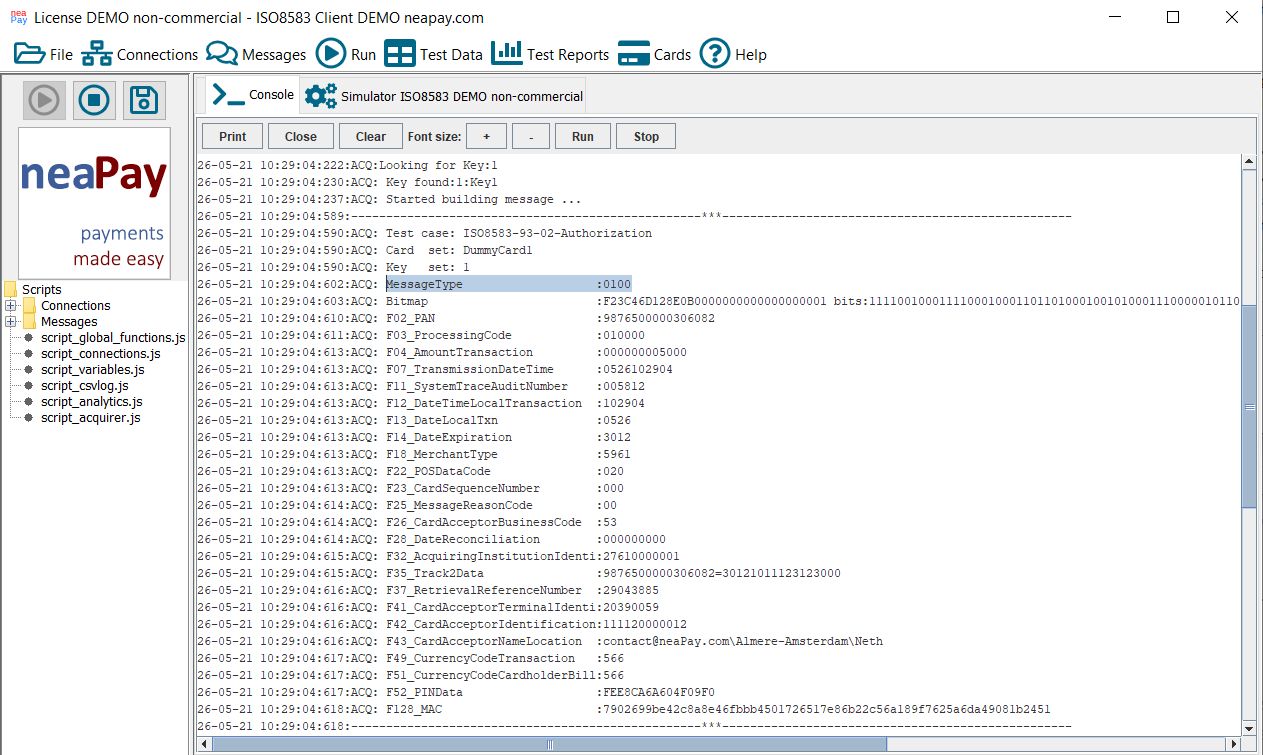
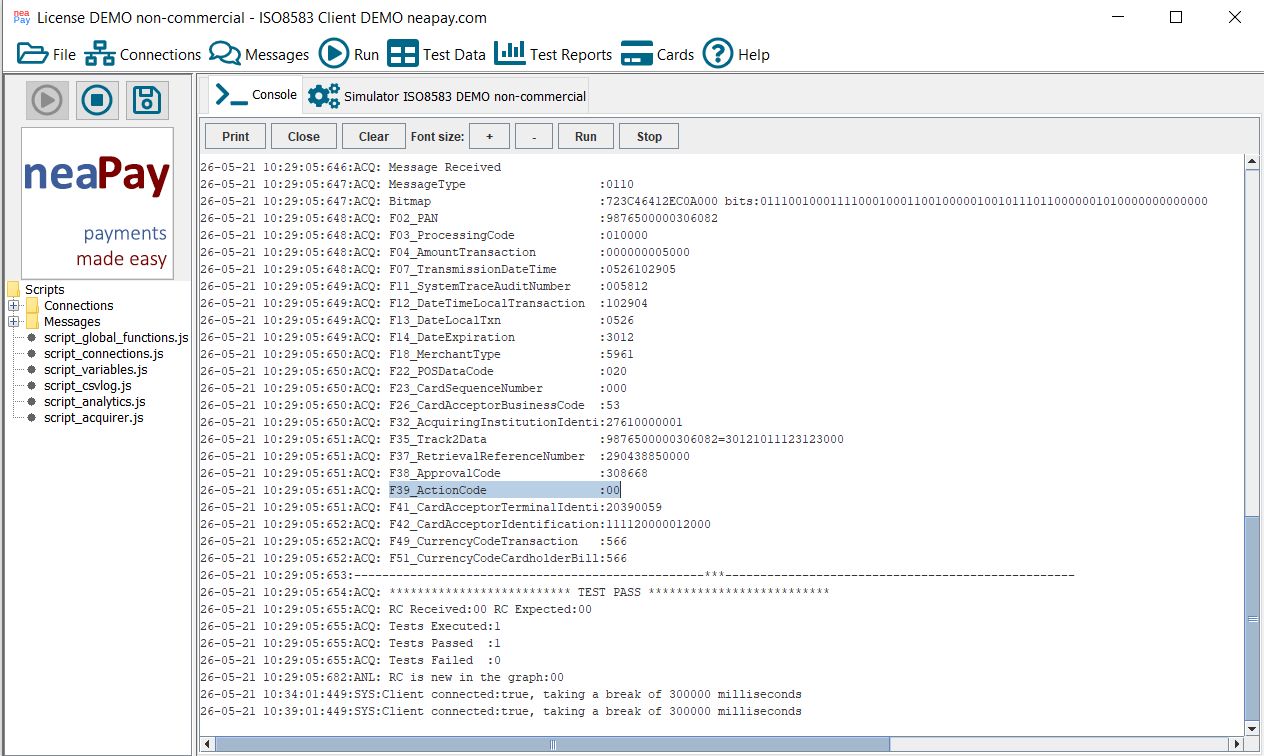
- ✅ Full ISO 8583 message simulation (POS, ATM, Host)
- ✅ Custom and scheme-ready packagers
- ✅ Multi-protocol support (TCP/IP, integrations)
- ✅ Real-time message inspection (hex + parsed)
- ✅ Negative scenarios and malformed message testing
- ✅ High-performance message generation
- ✅ Deterministic, auditable behavior
- ✅Multi-user for excellent team collaboration, work parallelization
- ✅Multi-project to be used accross schemees and versions
- ✅Multi-system across several test phases Dev, Sit, UAT DR
This immediately removes the burden of:
- Writing and maintaining internal simulation frameworks
- Explaining “why this test should matter” to auditors or partners
- Rebuilding the same tooling for every project
Buy vs Build: A CTO-Level Comparison
Build Internally
- ❌ Requires scarce payment experts for validation
- ❌ Long time to realistic simulation
- ❌ Hard to align with certification expectations
- ❌ Fragile tribal knowledge
- ❌ Continuous rework as specs or partners change
Hidden cost: delays, failed certifications, production surprises
Buy NeaPay ISO 8583 Simulator
- ✅ Payment-domain knowledge embedded in the product
- ✅ Immediate realism in testing and certification prep
- ✅ Consistent behavior across projects and teams
- ✅ Reduced dependency on individual experts
- ✅ Maintained and evolved externally
Visible value: speed, confidence, institutional resilience
Roadmap: Where the Platform Is Going (and Why It Matters)
To further increase buy‑over‑build value, NeaPay’s ISO 8583 Simulator roadmap focuses on risk elimination, not feature bloat.
1. Certification Acceleration Packs
- Scheme‑specific transaction flows
- Mandatory and negative test suites
- Exportable certification evidence
Impact: reduces certification cycles and dependency on senior experts
2. Stateful & Chaos Simulation
- Timeout and reversal orchestration
- Duplicate and delayed message injection
- Network and host failure modeling
Impact: exposes production‑only failures before production
3. AI‑Assisted Validation (Advisory, Safe)
- Automated test case suggestions
- Log and failure explanation
- Certification readiness scoring
Key principle: AI assists engineers—it never alters payment logic
Impact: preserves knowledge, accelerates troubleshooting, reduces expert bottlenecks
4. Performance & Volume Reality
- Traffic shaping by BIN, merchant, or time window
- Sustained TPS and latency measurement
- Load scenarios aligned with real acquirer behavior
Impact: confidence at launch, not surprises after go‑live
The Strategic Argument CTOs Care About
This decision is not about tooling cost.
It is about whether your payment platform depends on a small number of individuals—or on a system designed to survive audits, growth, and personnel change.
Organizations that buy an enterprise ISO 8583 simulator:
- Shorten delivery timelines
- Reduce institutional risk
- Preserve payments knowledge
- Free senior engineers to work on other tasks
Final Thought
You can build an ISO 8583 simulator.
But to validate it correctly, you still need the same scarce, expensive payment professionals—and you need them continuously.
NeaPay’s ISO 8583 Simulator embeds that expertise into software, turning payments simulation from a liability into a strategic asset.
For systems that move real money, certainty is never optional—it is engineered.