In the world of fintech and modern banking, the "Great Divide" is often defined by a single protocol: ISO 8583. It is the venerable, binary language of card payments—efficient and robust, yet notoriously difficult for modern web developers to speak.
As banks and PSPs race to launch new digital products, the question isn't just how to bridge ISO 8583 to a RESTful API, but how long it will take before the first transaction successfully clears.
The Industry Standard: Months to Years
Without a dedicated translation layer, a typical ISO 8583 to REST integration is a massive undertaking. Developers must manually handle:
-
Bitmaps and Variable-Length Fields: Parsing binary data where a single bit determines the existence of subsequent data fields.
-
Understanding and implementing documentation that is sometimes very vague.
-
Developing a somplete solution flow before the solution can even be functionally validated
- Handling binary data while scaling the traffic and handling many errors specific to TCP/IP ISO8583 which are encountered only once the scale is reached
-
Network Dialects: Managing the subtle differences between pISO8583 dialects like Visa, Mastercard, and proprietary host specifications.
- Expertise and built-in error handling on misalignements in documentation and implementation.
-
Security & HSMs: Integrating Hardware Security Modules for PIN translation and MAC validation.
-
State Management: Maintaining session keys and message echoes (0800/0810) in a stateless REST environment.
For most internal teams, building this from scratch takes 6 to 18 months, often resulting in "integration debt" and high maintenance costs.
The neaPay Timeline: From Days to Weeks
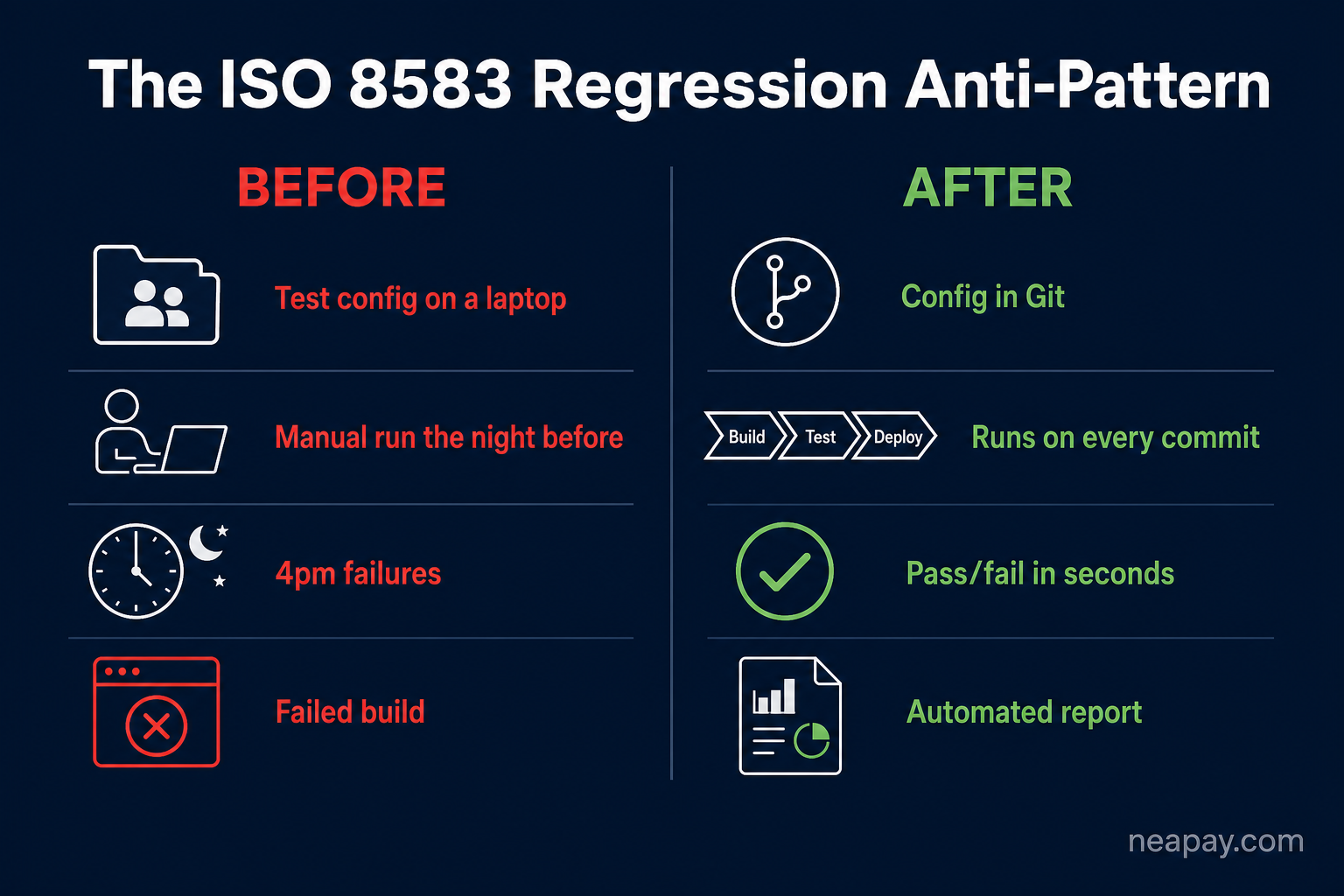
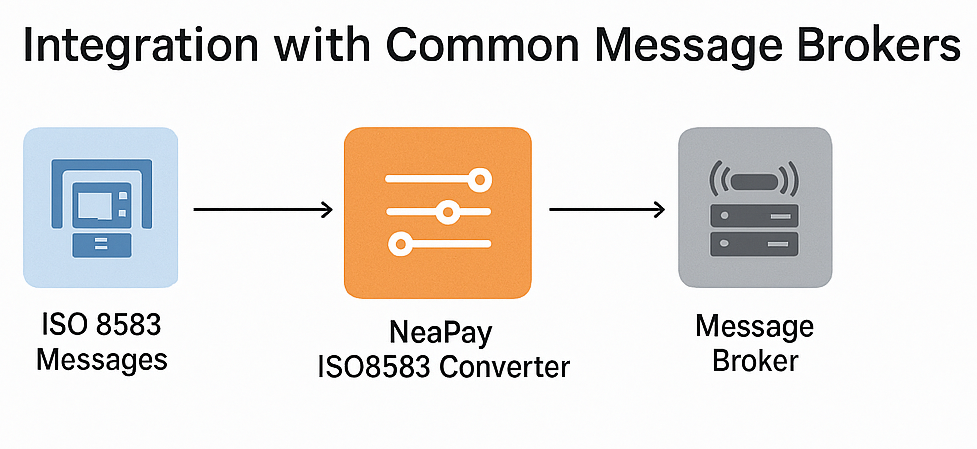
The neaPay ISO8583 Converter was built to eliminate this complexity by abstracting the protocol into structured JSON or XML. By using a pre-configured bridge, the timeline shifts dramatically:
1. Proof of Concept (POC): 2–3 Days
A functional POC shouldn't take a quarter of your year. With neaPay’s built-in dialects for major schemes, you can establish a connection and see your first ISO 8583 message converted into a JSON object in less than a week. This stage focuses on:
-
Connection establishment (TCP/IP).
-
Initial message building / parsing (Authorizations).
- Response building/handling
2. Minimum Viable Product (MVP): 2–4 Weeks
Moving from a POC to an MVP involves mapping specific business logic. Because neaPay uses a JavaScript-based configuration engine, your developers can write custom routing and transformation rules without recompiling the core engine. During this phase, you integrate:
-
Custom field mappings (Private fields).
-
HSM integration for secure cryptography.
-
Error handling and response code mapping.
3. Full Production Go-Live: 1–3 Months
The final stretch is rarely about the code—it’s about certification and compliance. neaPay accelerates this by being PCI DSS compatible out of the box and providing simulators for testing in isolation and integration (simulatoris like Visa and Mastercard). T
his allows you to perform pre-certification testing internally, reducing the back-and-forth with card schemes and cutting costs dramatically.
Why NeaPay Reduces Integration Time by 70%
-
Protocol Agnostic: Whether it's ISO8583 (87/93/2003 versions), ISO20022, or proprietary SQL formats, the converter handles the translation.
-
Infrastructure Agnostic: Deploy as a microservice in Docker, Kubernetes, or on-premise legacy servers (Linux, Windows, IBM Z).
-
High Performance: Sub-millisecond processing ensures that adding a translation layer doesn't introduce latency into the payment switch.
Conclusion
Integration doesn't have to be a multi-year roadmap.
By using a specialized converter, you can bridge the gap between legacy reliability and modern agility in a fraction of the time, allowing your team to focus on the user experience rather than binary bitmapping and cutting months of develeopment, especially in the beginning, when the investment does not show results untill all works in integration.
-
Specific Case Study Stats:
-
Customer Bank moved from a legacy system integration, pay per use, to their own back end via REST bridge? Results: POC in 3 days after requirements gathered, 3 months in testing to go-live. Cost reduction ~80% . Still processing strongly hundreds of thousands of transactions per day.
- Customer neoBank Connects existing acquirer payments on the POS network to interal new-developed Bank in an APP - Fintech. POC in about a week, then incremental releases for about 1 months then GO LIVE with a first batch of own cards.
- Card Processing Center requires onboarding a new acquirring nework - existing supplier quotes an enormous amount to customize their software to adopot a nwe ISO8583 dialect with custom security - neaPay delivers POC of the new integration in about a week and solves the custom security in about 2 more weeks, including customizations and alignment with HSM supplier
- new PSP on the market requires several integrations on the acquiring network for POS and e-commerce. neaPay delivers first intregration POC in 3 days , then a full plan for all mandatory intregrations, and a working full flow in about one month with several integrations.
-
-
The "Dialect" Advantage:
-
Many ISO8583 dialects are "ready to go" like Mastercard CIS and Visa Base I/II", and more of the common Processor networks..
-
Many confgurations readily available to deal with existing know customizations that are common when interfacing with some of the particular cases: BASE24-eps or legacy/classic on HISO, BIC ISO, Postilion POSTBRIDGE, Smartvista , FIN
-
-
Security/HSM Specifics:
-
several banking industry standard HSM brands (Thales, Futurex, AWS CloudHSM)?
-
On-premise hadling directly or over internet secure connections
-
-
Developer Experience (DX):
- Participating in dozens of these integrations allows us to deliver the experience to new projects and optimizing timelines and time to market while delivering huge cost reduction re-utilizing existing coponents, techniques and an establised platform that processes milions of transactions every day.