How Consultants and System Integrators Use the neaPay Simulator to Deliver Payment Projects Faster
Category: ISO8583 Simulator Target reader: CTO, Tech Architect, Payments Consultant Keywords: ISO8583 simulator consultant, payment integrator tools, system integrator ISO8583, payment project delivery tools, consultant payment testing
Payment integration consulting has a particular shape that distinguishes it from most other technology consulting engagements. The client has a business need — go live on a card network, connect a legacy system to an acquiring host, certify a new terminal deployment — and a deadline attached to that need. The consultant or system integrator is engaged to deliver the technical work within that deadline. And the technical work involves a protocol — ISO8583 — that is unforgiving of guesswork, opaque in its error responses, and dependent on external systems that operate on their own timeline regardless of the project's.
The consultants who consistently deliver payment projects on time are not the ones with the most ISO8583 knowledge, though knowledge matters. They are the ones who have structured their engagement methodology to compress the parts of the project that are compressible and to manage the parts that are not. The ISO8583 simulator is the primary tool that makes that compression possible, and the consultants who use it from day one of an engagement operate in a fundamentally different productivity regime from those who reach for it late or not at all.
This article is written for independent consultants, boutique payment integration firms, and system integrators who deliver ISO8583 integration projects. It explains how the simulator changes the economics of a payment project engagement, what the specific workflow looks like from project kickoff through client handover, and why the simulator belongs in the standard toolkit of every consultant who touches ISO8583 work.
The Consultant's Version of the Timeline Problem
The timeline problem in payment integration — the gap between the estimate and the actual delivery — is more acute for consultants than for internal teams. An internal team that misses its estimate faces internal pressure and project delay. A consultant who misses the estimate faces contract consequences, client relationship damage, and potential liability for milestone payments that were contractually tied to delivery dates.
Consultants also face a version of the problem that internal teams do not: the engagement start date is negotiated, but the external dependencies — scheme credentials, acquirer test environment access, certification session scheduling — are not. A consultant who signs a contract in January with a March go-live deadline cannot guarantee that the acquirer's test environment access will arrive before February, that the certification session will be available in the March window, or that the scheme's support team will respond to technical queries within the timeframe the project plan assumes.
These external dependencies are the primary source of project timeline risk in payment integration engagements, and they are the dependencies that the simulator most directly addresses. A consultant who deploys the simulator on day one of the engagement creates an internal test environment that is independent of all external dependencies — available immediately, available continuously, configurable to exercise any scenario the project requires. The external dependencies — scheme credentials, certification sessions, acquirer support — remain on the project plan, but they are not on the critical path until the integration has already been developed and validated against the simulator.
This dependency sequencing is the most important structural contribution the simulator makes to a consulting engagement. It means that the project's productive development phase is not gated on external access, and that external dependencies are engaged only when the integration is ready for them — which is when the interaction with those dependencies is most efficient.
Day One: The Simulator as the First Deliverable
In a payment integration engagement structured around the simulator, the first deliverable is not a requirements document or a project plan. It is a running test environment.
On day one of the engagement, the consultant deploys the neaPay simulator in the client's environment — or in a controlled environment the consultant manages — configured with the dialect profile that matches the target scheme and acquirer. By the end of day one, there is a functioning ISO8583 host that the client's team can connect to, that returns realistic responses to ISO8583 messages, and that logs every message exchange at the field level for diagnostic purposes.
This first deliverable has several effects that shape the rest of the engagement.
It demonstrates tangible progress immediately. Clients who have engaged a consultant to deliver a payment integration often have anxiety about whether the project is actually progressing, particularly in the early weeks when the visible output is mostly planning and architecture documentation. A running test environment is concrete, demonstrable evidence that the project is moving. The client's team can connect to the simulator and see their own messages being processed on day one, which builds confidence in the engagement and in the consultant's competence.
It gives the client's team something to work with immediately. In most payment integration engagements, the client has their own engineers who need to contribute to the integration — connecting their application to the new payment infrastructure, implementing the business logic that sits above the protocol layer, building the monitoring and reporting that surrounds the payment system. All of that work can begin on day one, because the simulator provides a realistic payment endpoint to develop against. The client's engineers do not wait for the real acquirer test environment; they start working against the simulator, which is more useful for their development purposes in any case.
It establishes the test methodology from the start. Beginning the engagement with a test environment in place means that testing is the default development mode, not an afterthought. Every piece of integration code is written to be tested against the simulator before it is considered complete. This practice, established on day one, produces a higher-quality integration than one where testing is added after the development phase.
The Engagement Workflow: From Simulator to Certification
The workflow that the simulator enables for a payment integration engagement has a clear structure that compresses the total timeline and makes the external dependencies manageable rather than critical.
Phase 1: Environment and baseline (days 1–3). Deploy the simulator with the target dialect profile. Establish the basic connection — TCP socket management, echo message handling, sign-on sequence. Validate that the connection is healthy and that basic message exchange works correctly. This phase is entirely self-contained: no external dependencies, no waiting, immediate validation. By the end of day three, the project has a working connection to a realistic ISO8583 host and a validated baseline to build on.
Phase 2: Core message flow development (weeks 1–3). Implement the core message types required by the integration: authorization requests and responses, reversals, network management messages. Each implementation is tested against the simulator as it is built, using the simulator's field-level diagnostic logging to identify and fix issues immediately. The certification test case library is obtained during this phase and the test cases are converted to simulator scenarios, so that the development testing is aligned with the certification requirements from the start. By the end of week three, the core message flows are implemented and validated against the simulator's certification scenario configuration.
Phase 3: Edge case and failure scenario coverage (weeks 3–5). Implement and test the edge cases and failure scenarios that the certification test case library requires and that production operation will encounter: timeout handling, reversal construction after timeout, partial approval handling, connection drop recovery, network management sequence. These scenarios are tested against the simulator's failure simulation capability, which produces the controlled failure conditions that cannot be replicated against a real scheme environment. By the end of week five, the integration handles every scenario in the certification test case library correctly — validated against the simulator, with the field-level logs as evidence.
Phase 4: Performance validation (week 5–6). If the project's performance requirements specify a TPS target — which most production deployments do — run the performance test suite against the simulator at the target TPS and sustained load duration. Identify and fix any performance bottlenecks revealed by the load test before the integration interacts with real infrastructure. By the end of week six, the integration is functionally complete, edge-case-tested, and performance-validated.
Phase 5: Scheme environment validation and certification (weeks 6–10+). With the integration fully validated against the simulator, engage the scheme's certification environment. The access request was submitted at the start of the engagement, during phase one, so the credentials should be available by the time the integration is ready to use them. Run the certification test cases against the real environment. Because the integration has already been validated against every certification test case using the simulator, the formal certification session is a confirmation rather than a discovery. First-session pass rates for integrations prepared this way are significantly higher than for integrations that enter certification without simulator-based pre-validation.
This workflow compresses the development phase into five to six weeks — not because the work is less, but because the feedback loop is fast and the external dependencies are not on the critical path until the integration is ready for them. The total engagement timeline is determined primarily by the certification process, which is external and cannot be compressed, rather than by the development phase, which is internal and can be.
The Diagnostic Workflow: From Error to Resolution in Hours
One of the most practically significant ways the simulator changes the consulting engagement experience is in the diagnostic workflow — the process of understanding and fixing a message handling issue.
In a consulting engagement without a simulator, the diagnostic workflow for a message handling issue looks like this: the integration sends a message to the scheme's test environment, the environment returns a rejection code, the consultant interprets the rejection code as best they can, forms a hypothesis about the cause, modifies the integration, submits again, and waits for the next response. If the hypothesis was wrong — if the rejection code was ambiguous and the modification did not fix the issue — the cycle repeats. If the issue requires clarification from the scheme's technical support team, a ticket is opened and the cycle pauses until the response arrives, typically days later.
In a consulting engagement with the simulator, the diagnostic workflow looks like this: the integration sends a message to the simulator, the simulator returns a rejection with a field-level explanation — "field 55 tag 9F26 (Application Cryptogram) length 8, expected length 8, actual length 7" — the consultant identifies the specific issue immediately, modifies the integration, submits again to the simulator, validates the fix in the same session. Total time from error to validated fix: minutes to hours, not days.
This difference compounds across the dozens of message handling issues that a typical payment integration project encounters. An engagement where each issue takes hours to resolve progresses at a fundamentally different pace from one where each issue takes days. Over the course of a project, the cumulative time saved by fast diagnostic resolution is measured in weeks — weeks that translate directly to earlier delivery and higher client satisfaction.
Managing Multiple Concurrent Engagements
Consultants and system integrators who work on multiple payment integration engagements simultaneously — which describes most boutique payment integration firms — face a resource allocation challenge that the simulator directly addresses.
Each engagement's development phase requires continuous access to a test environment. Without a simulator, that means continuous dependence on the scheme's test environment for each engagement simultaneously. The scheme's environment is a shared resource, available during defined hours, with limited diagnostic capability and no support for the failure scenario testing and performance testing that each engagement requires. Managing multiple engagements against a single shared external resource creates scheduling conflicts, diagnostic delays, and cross-engagement interference that is difficult to manage.
With a simulator, each engagement has its own independent test environment. The simulator for engagement A is configured with engagement A's dialect profile and scenario configuration. The simulator for engagement B is configured differently, for a different scheme and different certification requirements. Each engagement's test environment is independent, always available, and configurable to the specific needs of that engagement. There is no contention for a shared external resource, no scheduling conflicts, and no cross-engagement interference.
For a firm running three to five concurrent payment integration engagements, this independence is not just a convenience — it is an operational capability that determines how many engagements the firm can run simultaneously without degrading delivery quality on any of them. A firm without independent test environments for each engagement is constrained by the availability and capacity of external scheme environments. A firm with simulator-based test environments for each engagement is constrained only by its internal engineering capacity.
The Client Handover: Leaving a Test Infrastructure Behind
The deliverable of a payment integration consulting engagement is not just a working integration. It is a working integration that the client's team can maintain, extend, and operate after the consultant's engagement ends. The quality of that handover — how well-equipped the client's team is to take ownership of the integration — determines whether the engagement is a long-term success or a short-term fix that requires the consultant to be re-engaged repeatedly for maintenance.
The simulator is a component of the handover package that significantly improves the client's post-engagement capability. When the engagement ends, the client receives not just the integration code and configuration but the simulator, configured with the dialect profiles and scenario configurations used during the engagement, and the regression test suite that was built against those scenarios.
This handover gives the client's team three capabilities they would not have without the simulator.
The ability to test changes before deploying them. Every change the client's team makes to the integration after the consultant has left — a routing rule update, a new message type, a field mapping adjustment — can be tested against the simulator before it is deployed to production. Without the simulator, the client's team is limited to testing against the real scheme environment, with all the access, availability, and diagnostic constraints that implies.
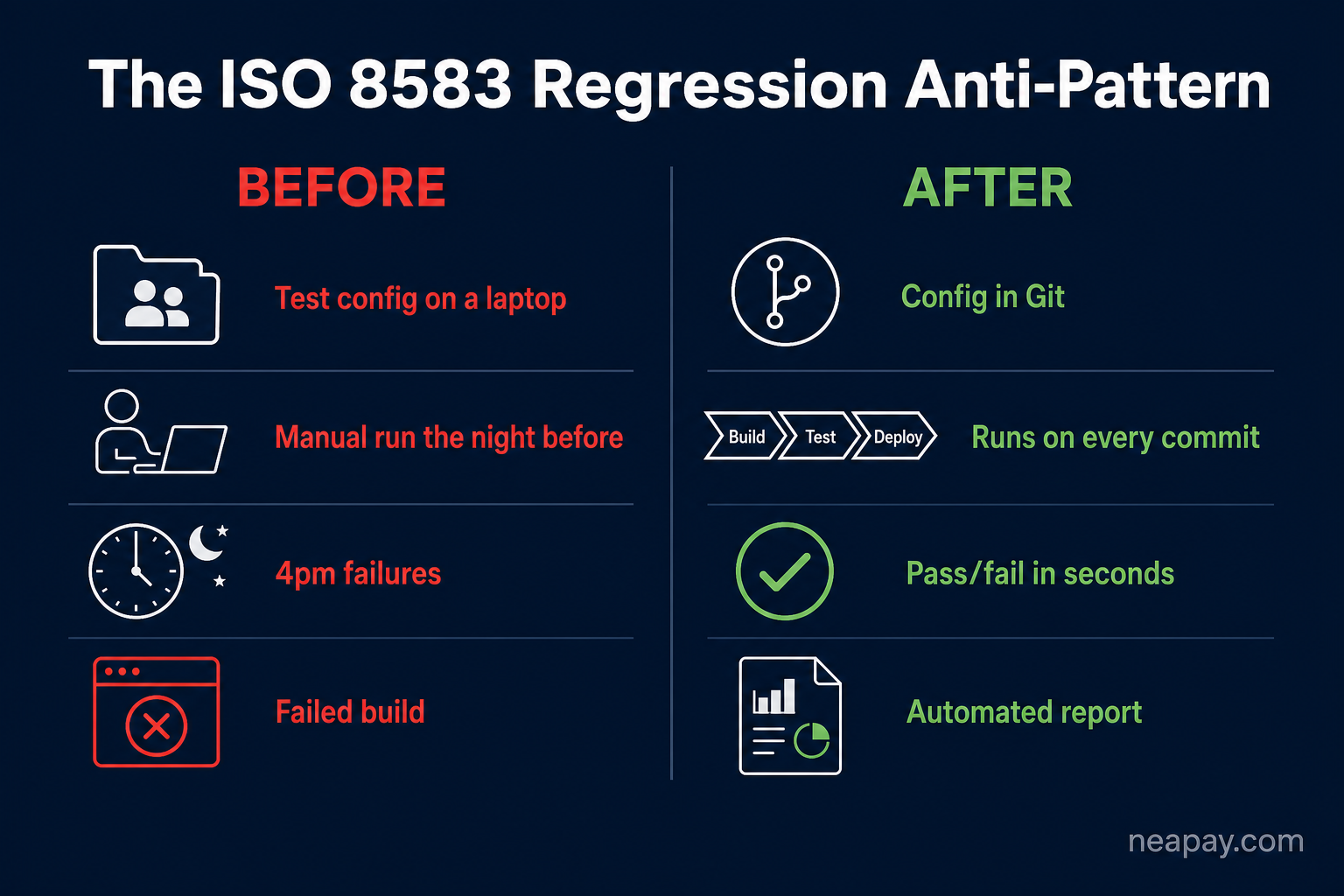
A regression suite that runs automatically. The regression test suite built against the simulator during the engagement continues to run in the client's CI/CD pipeline after the engagement ends. Every deployment is automatically validated against the suite. Regressions are caught before they reach production. The client's team does not need to re-engage the consultant every time a deployment introduces a regression — the suite catches it automatically.
A learning environment for new team members. When a new engineer joins the client's payments team, the simulator provides a safe environment to learn the message flows, experiment with message construction, and develop understanding of the protocol without needing credentials for the real scheme environment. The simulator is a training environment that requires no external access and produces no consequences for incorrect messages — making it the correct place to build protocol familiarity before working on production systems.
A consultant who delivers this handover package — integration, simulator, regression suite, documentation — is delivering something qualitatively different from a consultant who delivers only the integration code. The client team's ongoing capability to operate and maintain the payment infrastructure is materially higher, and the likelihood of re-engagement for avoidable maintenance issues is materially lower. This is the standard of delivery that distinguishes consultants who build long-term client relationships from those who complete transactions.
Pricing and Positioning the Simulator in Engagement Proposals
For consultants who do not currently include the simulator in their standard engagement toolkit, there is a practical question about how to position it in client proposals and whether to treat it as an additional cost or as part of the standard engagement scope.
The most effective positioning is to include the simulator as a standard component of every payment integration engagement, absorbed into the engagement pricing rather than itemized as an additional cost. The rationale is that the simulator is not an optional enhancement — it is the tool that makes the engagement's delivery timeline credible. An engagement without a simulator has a delivery timeline that is partly governed by external dependencies outside the consultant's control. An engagement with a simulator has a delivery timeline that is primarily governed by the consultant's own execution, with external dependencies managed at the edges.
When a client asks why the engagement is priced as it is, the answer includes the simulator as part of the methodology: "We deploy a simulator environment from day one, which means your team can start development work immediately and our development phase is not dependent on waiting for scheme credentials or certification environment access. This is how we consistently deliver on the timelines we commit to." This framing positions the simulator not as an additional cost but as the explanation for why the timeline commitment is reliable — which is a stronger selling point than a lower price with a less reliable timeline.
For consultants who prefer to itemize the simulator as a separate line item, the framing is similar: the simulator is the tool that makes the delivery methodology work, and the cost of the simulator is a fraction of the cost of a single failed certification session or a single timeline slip due to external environment dependencies.
The Competitive Advantage That Compounds
Consultants who adopt the simulator-based engagement methodology early build a competitive advantage that compounds over time through two mechanisms.
The first is delivery reliability. Engagements that are structured around the simulator consistently deliver closer to their committed timelines than engagements that are not. This reliability becomes part of the consultant's track record — a demonstrable history of on-time delivery on payment integration projects that is visible to prospective clients and differentiated from consultants whose delivery timelines are more variable. In a market where payment integration engagements are high-stakes and timeline misses have serious consequences, a track record of reliable delivery is a significant competitive differentiator.
The second is engagement scope expansion. A consultant who delivers the simulator as part of the handover package gives the client a reason to return for subsequent engagements — not because the integration broke, but because the client now has a test infrastructure that supports expansion and the consultant is the person who knows it best. New scheme integrations, new message type support, new acquirer relationships — each of these is a natural extension of the initial engagement, and a client who is well-served by the initial engagement is the most reliable source of subsequent work.
Both mechanisms favor the consultant who adopts the simulator methodology early. The consultant who adopts it late is catching up to a practice that is already differentiating their competitors.
Using the neaPay simulator on your next payment integration engagement? neaPay provides consultant and system integrator licensing options that cover multiple simultaneous engagements, with pre-built dialect profiles for the most common scheme variants and certification scenario configurations that accelerate the engagement setup. Reach out to discuss how the simulator fits into your engagement methodology and what the licensing options look like for your engagement volume.