How to Integrate ISO8583 with Your Existing SQL Database Without a Middleware Team
Category: ISO8583 Converter Target reader: CTO, Tech Architect, Payments Consultant Keywords: ISO8583 to SQL, ISO8583 database integration, ISO8583 field mapping SQL, payment data to database, ISO8583 ETL alternative
Every payment transaction generates data. Authorization requests, responses, reversals, settlements — each one carries dozens of data elements that your business needs to store, query, report on, and audit. For most organizations, that means getting ISO8583 message data into a relational database: a PostgreSQL instance, a MySQL cluster, a SQL Server environment, an Oracle database sitting at the core of a core banking system.
The question that stumps more architects than it should is: how do you get data out of an ISO8583 message and into a SQL table without building a custom extraction pipeline, without a dedicated middleware team, and without becoming dependent on engineers who understand both payment protocols and database integration simultaneously?
This article walks through why that question is harder than it looks, and how a well-designed ISO8583 converter makes it straightforward.
The Data Problem Inside Every ISO8583 Message
An ISO8583 message is not a row in a database. It is a binary-encoded structure where the presence and absence of fields is indicated by a bitmap, where field values are encoded in formats that SQL cannot natively consume, and where the meaning of specific fields varies depending on the message type, the scheme, and the processing context.
Consider what a single authorization request message contains. Field 2 holds the Primary Account Number — the card number — encoded as a LLVAR numeric string of up to 19 digits. Field 4 holds the transaction amount as a 12-digit fixed-length numeric string, with the last two digits representing decimal places but no decimal point present. Field 12 holds the local transaction time as a 6-digit HHMMSS string. Field 22 holds the point-of-service entry mode as a 3-digit code where each digit position carries separate meaning. Field 55 holds EMV chip data as a binary blob of variable length, itself internally structured as a series of BER-TLV encoded tags.
None of these are ready for direct insertion into a SQL column. The amount needs decimal point restoration. The timestamp needs to be combined with the date from field 13 and converted to a datetime type. The entry mode needs to be decomposed into its component parts. The EMV blob needs to be either stored as binary and parsed on read, or parsed at ingestion and distributed across multiple columns. The card number, if you are storing it at all, needs to be tokenized or masked to satisfy PCI-DSS requirements.
And that is just the data transformation problem. Before you even get there, you need to extract the field values from the binary message, which means correctly parsing the bitmap, handling LLVAR and LLLVAR length prefixes, applying the right character encoding for each field, and doing this reliably for every message type your system will receive.
What a "Simple" Custom Pipeline Actually Requires
When architects sketch out an ISO8583-to-SQL pipeline on a whiteboard, it looks manageable. Receive the message, parse the fields, transform the values, write to the database. Four boxes. An afternoon's work.
The actual implementation is none of those things.
Parsing layer: You need a reliable ISO8583 parser that handles your host's specific dialect — field definitions, encoding rules, bitmap structure, and private-use field specifications. As covered in earlier articles, this is a multi-month undertaking for a team without prior ISO8583 experience.
Transformation layer: Every field that goes into a SQL column needs a defined transformation rule. Amount fields need decimal restoration. Date and time fields need normalization and combination. Coded fields need lookup tables or decomposition logic. Binary fields need a storage and retrieval strategy. These rules need to be implemented, tested, and maintained as your schema evolves.
Schema design: Your SQL schema needs to accommodate the full breadth of message types you will receive — authorizations, reversals, adjustments, network management messages — while remaining queryable for the business reporting and audit use cases you actually care about. Getting this wrong early means expensive migrations later.
Error handling: What happens when a message arrives with a field your parser does not expect? What happens when a transformation fails because a field value does not conform to the expected format? What happens when the database write fails after the message has already been acknowledged? These failure modes need explicit handling, and getting them wrong means either lost transactions or duplicate records — both of which are serious problems in a payment context.
Volume and latency: Payment systems process transactions in real time. Your pipeline needs to keep up with peak transaction volume without introducing latency that affects authorization response times, and without creating a backlog that grows unboundedly during traffic spikes.
Ongoing maintenance: Every time your scheme updates its specification, every time your host changes a field definition, every time your business adds a new transaction type, the pipeline needs to be updated. That maintenance requires the same combination of ISO8583 protocol knowledge and database integration expertise that built it in the first place.
This is not an afternoon's work. It is a significant engineering investment that requires sustained expertise to maintain.
The Middleware Team Problem
Large payment processors handle this with dedicated middleware teams: engineers who own the integration layer between the payment protocol world and the data persistence world. They write the parsers, maintain the transformation rules, manage the schema migrations, and own the pipeline's operational health.
Most organizations building payment functionality are not large payment processors. They are fintechs, banks building digital products, software companies adding payment acceptance, or retailers integrating with an acquiring partner. They do not have — and cannot justify — a dedicated middleware team for payment data integration.
What they end up with instead is one or two engineers who built the pipeline and now own it indefinitely alongside their other responsibilities. When those engineers move on, the pipeline becomes a black box that everyone is afraid to touch. When the scheme updates its specification, the update waits until someone can free up the time to figure out the original implementation well enough to change it safely.
This is a common and painful situation. It is also entirely avoidable.
How the neaPay Converter Handles SQL Integration
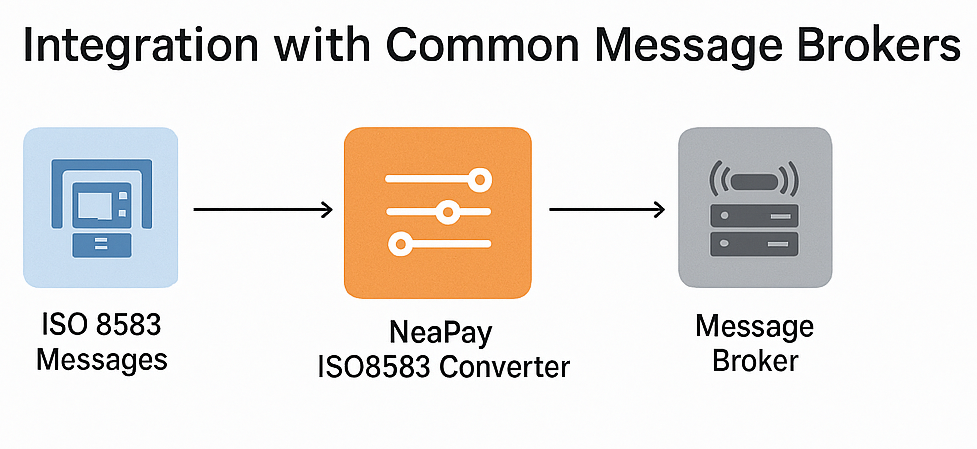
The neaPay ISO8583 Converter does not just translate between ISO8583 and REST. It includes a direct SQL integration capability that handles the full path from ISO8583 message to database row without requiring a custom pipeline.
The converter maintains a persistent connection to your SQL database alongside its connection to the card scheme or acquiring host. When a message is received or sent, the converter extracts the field values, applies the configured transformation rules, and writes the result directly to your database tables according to a mapping configuration you define. Your application team does not write parsing code, transformation logic, or database write handlers. They define what they want stored and where, and the converter handles the rest.
Field mapping configuration: The converter ships with a configuration layer where you specify which ISO8583 fields map to which database columns. For each field, you can define transformation rules: decimal restoration for amount fields, datetime construction from date and time field combinations, code decomposition for multi-meaning coded fields, masking or tokenization for card number fields. These rules are defined in configuration, not in code, which means they can be updated without a development cycle.
Support for standard SQL databases: The converter supports direct integration with PostgreSQL, MySQL, SQL Server, and Oracle — the databases that appear most commonly in enterprise and fintech environments. If your stack uses one of these, no additional database driver work is required from your team.
Multiple table writes per message: A single ISO8583 message can trigger writes to multiple tables simultaneously. A common pattern is to write the core transaction record to a transactions table, the authorization result to an authorizations table, and the raw message to an audit log table — all from a single message event. The converter handles these as a configured set of write operations, executed within a transaction to ensure consistency.
Handling message types distinctly: Authorization requests, authorization responses, reversals, and adjustments each have different field sets and different database write requirements. The converter's mapping configuration is message-type-aware, so you can define different write behaviors for each message type without conditional logic in application code.
Raw message archiving: In addition to structured field writes, the converter can store the full raw ISO8583 message — either as a hex string or as a parsed JSON representation — in an audit table. This supports regulatory requirements, dispute resolution, and debugging scenarios where you need to inspect the original message rather than the transformed version.
What Your Database Team Actually Needs to Do
The work that remains on your side is the work your team is already equipped to do: database schema design.
Your team decides what tables to create, what columns to define, and what indexes to build for your reporting and query patterns. That is standard SQL design work — no payment protocol knowledge required. Once the schema exists, the field mapping configuration is written to describe how ISO8583 fields land in those columns. The neaPay documentation provides field reference tables — human-readable descriptions of what each ISO8583 field contains, in what format, and with what typical values — so your team can make informed schema decisions without needing to understand the protocol itself.
The converter handles everything between the card scheme and your database. Your team handles everything from the database onward — queries, reports, business logic, APIs that read the stored transaction data. The protocol complexity is contained inside the converter, invisible to the database integration layer entirely.
A Common Schema Pattern
While every organization's data needs are different, a common starting point for ISO8583 transaction storage looks something like this.
A core transactions table captures the essential fields present in every message: a generated internal transaction ID, the message type indicator, the systems trace audit number from field 11, the local transaction datetime constructed from fields 12 and 13, the processing code from field 3, and the acquiring institution identifier from field 32. This table serves as the master record for every message event.
An authorizations table captures the fields specific to authorization flows: the masked or tokenized PAN from field 2, the transaction amount with decimal restoration from field 4, the currency code from field 49, the response code from field 39, the authorization identification response from field 38, and the card acceptor identification from field 42. This table is typically the primary target for business reporting and settlement reconciliation.
A reversal tracking table captures reversal-specific fields, linked to the original authorization by STAN and retrieval reference number, allowing the system to match reversals to their originating transactions for accurate balance and liability tracking.
An audit log table captures the full raw message alongside a timestamp and internal transaction ID, supporting compliance, dispute resolution, and debugging without relying on the structured tables to preserve every detail.
This schema handles the majority of payment data use cases without requiring any ISO8583 protocol knowledge to query or maintain. Once it is populated by the converter, it looks and behaves like any other relational data store — queryable with standard SQL, reportable with standard BI tools, and maintainable by any database engineer on your team.
The Compliance Angle
One concern that comes up consistently when storing ISO8583 data in SQL is PCI-DSS compliance. Card numbers — PANs — are in scope for PCI-DSS, and storing them incorrectly creates significant compliance liability.
The neaPay converter addresses this directly in the field mapping configuration. PAN values can be masked at the converter level before they reach the database, so only the first six and last four digits are stored and the middle digits are replaced with a masking character. Alternatively, if your environment uses a tokenization service, the converter can be configured to pass the PAN through a tokenization step before the database write, so the stored value is a token rather than a real card number.
Either approach means your SQL database never holds a full unmasked PAN, which substantially reduces your PCI-DSS scope and compliance burden. Your DBA team does not need to implement this logic themselves — it is configured in the converter's field mapping layer and applied consistently to every message.
Removing the Middleware Dependency Entirely
The promise of this approach is not just faster integration. It is the permanent removal of a specialized dependency from your engineering organization.
With a custom pipeline, you have middleware — either a dedicated team or a fragile single-owner implementation — sitting between your payment protocol and your database, owned by people with a specific combination of skills that are hard to replace and harder to document. Every change to the scheme, the host, or your schema touches that middleware. Every team reorganization puts it at risk.
With the neaPay converter handling the ISO8583-to-SQL path, there is no middleware in the traditional sense. There is a configured product that your team operates, backed by a vendor whose core competency is exactly this problem. Your schema is yours. Your queries are yours. The protocol complexity belongs to the converter, and the converter belongs to people who think about ISO8583 every day.
That is the architecture that scales — not because it is more clever, but because it does not create dependencies that compound over time.
Ready to see how your transaction data model maps to ISO8583 fields? neaPay engineers can walk through your schema requirements and show you exactly how the converter's field mapping configuration would handle your specific message types and database targets. No protocol expertise required from your side — just bring your data model.