How to Run Visa and Mastercard Certification Testing Without a Payments QA Team
Category: ISO8583 Simulator Target reader: CTO, Tech Architect, Payments Consultant Keywords: Visa Mastercard certification testing, ISO8583 certification simulator, card scheme test cases, payment certification QA, ISO8583 test automation certification
Card scheme certification is the gate between a working payment integration and a live payment integration. You can build the most technically correct ISO8583 implementation in the world, but until Visa or Mastercard has formally validated that it meets their requirements, you cannot process real transactions on their networks. The certification process is not a formality — it is a structured technical assessment that requires demonstrating correct message handling across a comprehensive set of scenarios, many of which are far from the happy path your development testing covered.
The assumption most organizations make when they encounter this requirement is that passing it requires a specialized payments QA team: engineers who know the scheme test case libraries, who understand what each test case is validating, who can interpret the scheme's certification feedback, and who have done this enough times to know where the common failure points are. That assumption is understandable. It is also, with the right tooling, incorrect.
This article explains what Visa and Mastercard certification testing actually requires, where the complexity genuinely lives versus where it appears to live, and how a well-configured ISO8583 simulator lets a lean engineering team prepare for and pass scheme certification without dedicated payments QA expertise.
What Scheme Certification Actually Assesses
Before addressing how to prepare for certification, it is worth being precise about what certification is testing. The answer shapes the preparation strategy more than any other single factor.
Scheme certification is not testing whether your integration works in general. It is testing whether your integration handles the specific scenarios the scheme has defined as mandatory for any participant on their network. The distinction matters because it means certification preparation is not open-ended — it has a defined scope, a defined set of test cases, and a defined set of pass criteria. The test case library is provided to you before the certification process begins. The scenarios you need to pass are known in advance. The preparation task is to ensure your integration handles each of those scenarios correctly — not to discover unknown requirements, but to validate known ones.
The Visa certification programme and Mastercard's equivalent each maintain test case libraries that cover several broad categories.
Authorization flows. Basic approval and decline scenarios across card types — credit, debit, prepaid — and transaction types — purchase, cash advance, quasi-cash. These are the foundational test cases that any implementation must pass, and they are also the ones most development teams feel confident about after their own testing.
Partial approval handling. Scenarios where the authorized amount differs from the requested amount — a prepaid card with insufficient balance for the full amount — and where the integration must correctly handle the partial approval response and communicate the authorized amount accurately to the cardholder.
Reversal flows. Scenarios that test whether the integration correctly initiates reversals in the scenarios that require them: authorization timeouts where no response was received, authorization responses received after the timeout period, and system-initiated reversals for technical failures. Reversal handling is one of the most common areas where implementations fail certification, because reversals require correct message construction under conditions — timeouts, missing responses — that are difficult to test without a simulator that can simulate those conditions on demand.
Stand-in processing. Scenarios where the issuer is unavailable and the scheme's stand-in processing system responds on the issuer's behalf. The integration must correctly handle stand-in response codes and follow the appropriate post-authorization procedures.
Network management messages. Echo request and response handling, sign-on and sign-off message flows, and the network management message sequences that the scheme requires for connection establishment and session management.
EMV chip data handling. For card-present integrations, test cases that validate the correct construction of field 55 — the EMV data field — across different chip card scenarios: contact chip, contactless, fallback to magnetic stripe.
Error handling. Test cases that deliberately submit malformed or incomplete messages to validate that the integration returns the correct error responses rather than crashing, hanging, or returning incorrect response codes.
The complete test case library for either Visa or Mastercard runs to dozens of individual test cases across these categories. Each test case specifies the message to be submitted, the expected response, and the pass criterion. None of this is secret — it is documented and provided to integration partners as part of the certification engagement.
What the test case library does not provide is a way to run the test cases in your own environment before entering the formal certification process. That is what the simulator provides.
Where the Real Complexity Lives
When teams without prior certification experience estimate the difficulty of scheme certification, they tend to overestimate the complexity of the test cases themselves and underestimate the complexity of the certification process mechanics.
The test cases themselves are technically precise but not technically exotic. They require correct ISO8583 message construction, correct field values, correct response handling, and correct message sequencing. These are the same requirements that the integration must meet for every live transaction. A team that has built a correct ISO8583 implementation should be able to understand what each test case requires and implement the handling it calls for.
The process mechanics, by contrast, create friction that has nothing to do with technical capability.
Certification environment access is restricted and procedural. Getting access to the scheme's certification environment requires completing a formal engagement process — submitting an application, signing agreements, receiving credentials through a process that takes weeks. The certification environment is not a public sandbox that you can access on demand.
Certification sessions are scheduled and finite. The formal certification process involves scheduled sessions with the scheme's certification team. You submit messages during a session window, the scheme team reviews the results, and feedback is provided. If you fail test cases, you remediate and schedule another session. Each session scheduling cycle adds one to three weeks to the project timeline.
Certification feedback is often terse. When a test case fails, the scheme's feedback is typically a rejection code and a brief description — "field 55 encoding error," "incorrect reversal message type," "echo response timeout." The feedback identifies what failed; it does not always explain precisely why. Diagnosing the underlying cause requires protocol knowledge that a team without prior certification experience may need to develop through iteration — which means multiple failed sessions before the root cause is understood and corrected.
Certification environments are not debugging environments. You cannot step through message handling in a certification environment. You cannot configure the environment to exercise a specific failure scenario. You cannot examine the raw bytes of a message that was rejected to understand exactly where the encoding went wrong. The certification environment tells you whether you passed or failed each test case. It does not help you understand why you failed.
The simulator addresses every one of these friction points. It provides an environment where test cases can be run before the formal certification session, where feedback is immediate and detailed, where failure causes are visible in the message trace logs, where specific scenarios can be reproduced and iterated on without scheduling constraints, and where the integration can be validated against the full certification test case library before a single session slot is consumed.
Running Certification Test Cases Against the Simulator
The preparation workflow that eliminates certification failures is straightforward, and it requires no payments QA expertise to execute — only familiarity with the scheme's test case documentation and the simulator's configuration interface.
Step one: obtain the test case library. The scheme's test case library for your integration type — card-present, card-not-present, specific merchant category, specific geographic market — is available from the scheme or from your acquiring bank's technical team. This documentation specifies every test case you will need to pass, including the input message parameters, the expected response, and the pass criterion. Obtain this before any integration development begins, because it is effectively the specification your integration needs to meet.
Step two: configure the simulator for each test case. Each test case in the library requires a specific response from the host — an approval, a specific decline code, a partial approval, a refersal, a timeout. Configure the simulator to return the required response for the card number or transaction parameters specified in the test case. The neaPay simulator's scenario configuration allows any combination of card number, transaction type, and amount to be mapped to any configured response, including response timing simulation for timeout test cases.
Step three: execute the test cases against the simulator. Run each test case exactly as specified in the library — same card data, same transaction parameters, same message sequence. The simulator returns the configured response and logs the complete message exchange at the field level. Review the response against the test case's expected response and pass criterion. Where they match, the test case is ready for the formal certification session. Where they do not match, the simulator's field-level log identifies exactly what was sent and what was received, making the discrepancy immediately diagnosable.
Step four: remediate and re-run. When a test case does not produce the expected result, the simulator's detailed logging identifies the specific issue — a field missing from the message, an incorrect encoding, a wrong message type for a reversal, a response code that was not handled correctly. The issue is fixed in the integration code, the test case is re-run against the simulator, and the result is verified. This cycle runs in your environment, on your schedule, with no external dependencies.
Step five: enter the formal certification session with a verified test suite. When every test case in the library produces the expected result against the simulator, the integration is ready for the formal certification session. The session is used to demonstrate what has already been validated internally — not to discover issues for the first time.
This workflow is executable by any backend engineer who can read the test case documentation and operate the simulator's configuration interface. It does not require a payments QA specialist. It requires methodical execution of a defined process against a well-documented test case library, using a simulator that provides immediate, actionable feedback at every step.
The Test Cases That Catch Most Teams Off Guard
Within the certification test case library, a subset of scenarios accounts for a disproportionate share of certification failures. These are worth understanding specifically, because they are the scenarios where the simulator's value is highest — where failure in the formal certification session is most costly and where pre-certification validation in the simulator most directly prevents that failure.
Reversal on timeout — no response received. The test case submits an authorization request and deliberately does not return a response within the integration's timeout window. The integration must detect the timeout, initiate a reversal message, and send it correctly. The failure mode: many implementations detect the timeout correctly but construct the reversal message incorrectly — wrong message type indicator, wrong field set, incorrect reference to the original transaction's STAN. The reversal message construction is not tested in normal authorization flow testing because normal authorization flows do not time out. Without a simulator that can simulate a non-response, this failure is not discovered until the certification test case is executed — and if the first execution is the formal certification session, the failure costs a session slot and a scheduling cycle.
Reversal on timeout — late response received. The test case submits an authorization request, the integration times out and sends a reversal, and then — after the reversal has been sent — the original authorization response arrives. The integration must handle this sequence correctly: process the late response, reconcile it against the reversal, and ensure the transaction outcome is determined correctly. This is one of the most complex message flow scenarios in the certification library and one of the least likely to be correctly implemented without explicit testing. The simulator can produce this exact sequence — delayed response arriving after the reversal — with precise timing control.
Partial approval — incorrect amount handling. The test case returns a partial approval response with an authorized amount lower than the requested amount. The integration must extract the authorized amount from the response correctly, not assume that approval means the full amount was authorized. Failure mode: the integration reads the response code (approved) without reading the response amount, and reports the full requested amount as authorized. The simulator can be configured to return partial approvals for any card number or amount, making this scenario testable on demand.
Echo message failure — connection health. The test case validates that the integration correctly handles a failure to receive an echo response from the host — specifically, that the integration detects the connection as unhealthy and takes the correct action (reconnection, failover, or graceful degradation depending on the configuration). Without a simulator that can deliberately fail to respond to echo messages, this behavior is not testable in a development environment.
Field 55 encoding — EMV data. For card-present integrations, field 55 carries the EMV chip data as a BER-TLV encoded structure. The certification test cases validate that specific EMV tags are present and correctly encoded for different chip transaction scenarios. Failure mode: the tags are present but encoded incorrectly — a tag value length that is off by one byte, a tag order that does not match the scheme's requirement, a mandatory tag that is absent in a specific transaction type. The simulator's field-level validation identifies these encoding issues immediately; a real certification environment returns a rejection code that identifies the field but not the specific encoding problem.
Network management sequence. The test cases validate the sign-on and sign-off message sequence that the integration must execute when establishing and terminating a connection. Many integrations implement echo message handling correctly but implement the sign-on sequence incorrectly — missing a required field, using the wrong message type for the sign-on request, or not handling the sign-on response correctly before sending the first authorization. The simulator implements the full network management message sequence and returns scheme-correct responses, making this testable from the first connection attempt.
Pre-validating all of these scenarios against the simulator before entering the formal certification session converts the certification process from a discovery exercise into a confirmation exercise. The issues that would have caused certification failures have already been found and fixed. The formal session confirms that the integration meets the scheme's requirements — which it does, because the simulator already confirmed it.
Automating the Certification Test Suite
One of the less obvious benefits of simulator-based certification preparation is that the test case execution can be automated. Each test case specifies a defined input and a defined expected output. This is the structure of a test case in any automated test framework — it is not specific to payment certification.
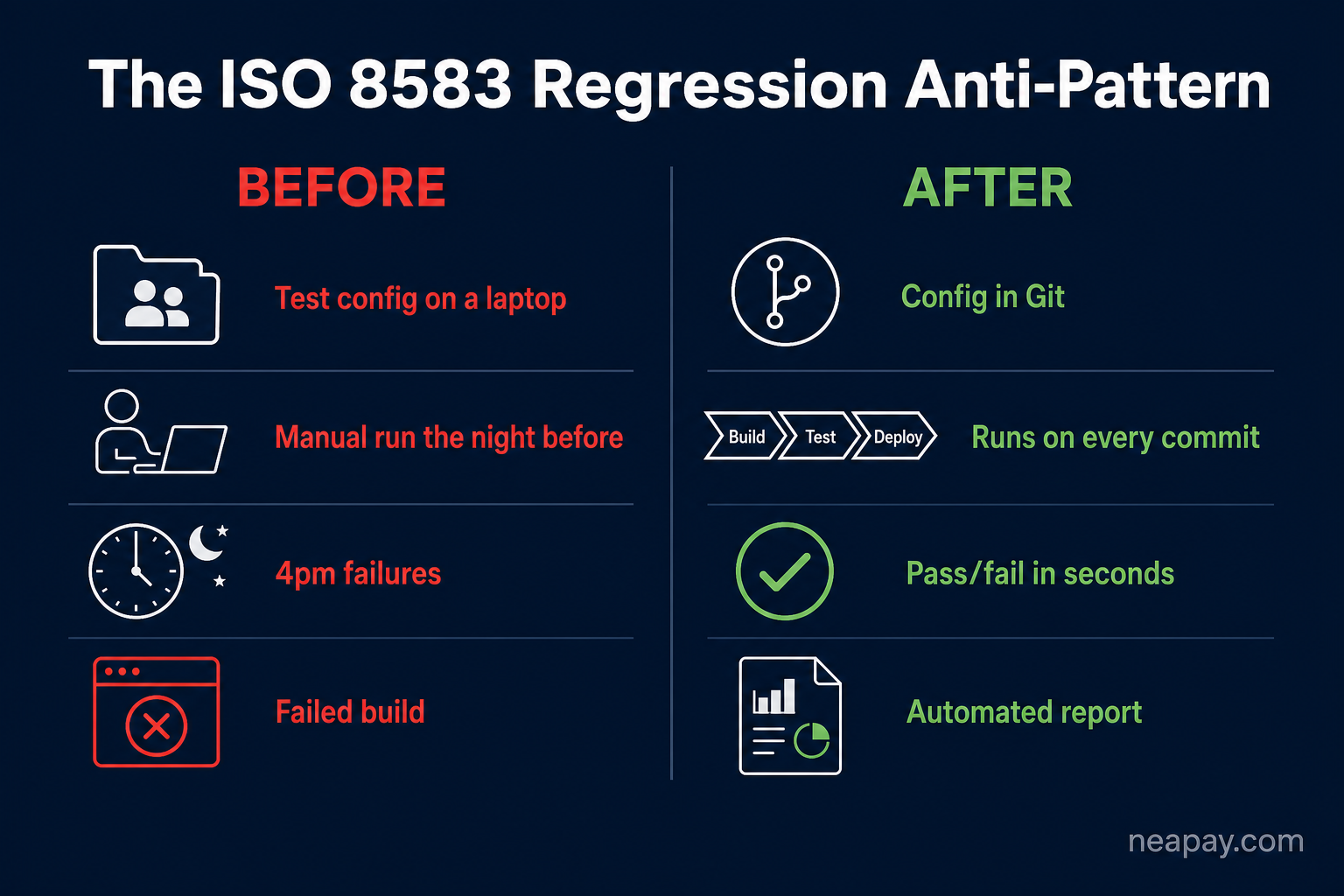
A team that scripts their certification test cases against the simulator — using any standard test automation tooling, with the simulator as the target endpoint — creates a regression test suite that can be run automatically on every code change. Every time the integration is modified, the full certification test suite runs against the simulator and validates that all test cases still produce the expected result. A change that introduces a certification failure is caught automatically, before it reaches the formal certification session and before it reaches production.
This automation converts a one-time certification preparation activity into a continuous integration check. The certification test suite becomes the payment integration's regression safety net — the automated validation that confirms every deployment maintains the behavior that scheme certification requires.
Building this automation requires no payments QA expertise. It requires familiarity with a test automation framework and the simulator's interface — the same skills any backend engineering team uses for API integration testing. The payment-specific knowledge is in the test case configuration, which is derived directly from the scheme's test case library documentation.
The QSA Analogy That Makes the Value Clear
The value of the simulator for certification preparation is analogous to the value of a mock exam for a professional qualification. A candidate who studies the subject matter and sits the exam without any practice against exam-format questions will encounter surprises on exam day — not because they lack knowledge, but because the exam format, the question phrasing, and the time pressure introduce variables that subject knowledge alone does not prepare you for. A candidate who completes multiple practice exams under realistic conditions arrives at the real exam having already encountered the surprises, resolved the uncertainties, and calibrated their approach against the actual assessment format.
Scheme certification is the exam. The simulator is the practice environment. An integration team that has run every certification test case against the simulator before entering the formal session arrives knowing exactly what the certification session will produce — because they have already produced it, in their own environment, with full diagnostic visibility. The formal session is the confirmation, not the discovery.
A dedicated payments QA team provides value in environments where payment integrations are built frequently and where institutional knowledge of scheme certification requirements is worth accumulating across multiple projects. For an organization building its first or second payment integration, that institutional knowledge does not exist yet and cannot be hired quickly. The simulator provides a structured path to the same outcome — a passing certification — without requiring the institutional knowledge to pre-exist.
What Your Team Needs to Execute This
The team that successfully runs certification test cases using the simulator and passes the formal certification session on the first or second attempt is not a specialized payments QA team. It is a backend engineering team that has access to the right documentation and the right tooling.
The documentation they need is the scheme's test case library for their integration type. This is obtained from the scheme through the certification engagement process or from the acquiring bank's technical team. It is a defined document with a defined scope — not open-ended research.
The tooling they need is the neaPay ISO8583 Simulator, configured with dialect profiles that match the target scheme and acquirer, and with scenario configurations that implement the response behaviors specified in the test case library. neaPay provides pre-built configurations for the most common certification scenarios and documentation that maps the test case library requirements to simulator configuration parameters.
The process they need to follow is the five-step workflow described earlier in this article: obtain the test case library, configure the simulator, execute each test case, remediate failures, and enter the formal session with a validated test suite. This process is methodical and executable by any competent backend engineer. It does not require expertise that is not acquired through executing the process itself.
The formal certification session will still require engagement with the scheme's certification team and familiarity with the scheme's certification process mechanics — scheduling, submission procedures, feedback interpretation. neaPay engineers can support this engagement, providing guidance on certification process mechanics and interpretation of scheme feedback when it is not self-explanatory.
Planning a Visa or Mastercard certification and want to map your test case requirements to a simulator configuration before the first session? neaPay engineers can review your certification test case library, identify the scenarios most likely to cause failures without pre-validation, and configure the simulator to cover all of them before your first session is scheduled. Bring your test case documentation and your integration timeline; the preparation conversation takes an afternoon.