ISO8583 Regression Testing: How to Protect Every Deployment Without a Dedicated Test Team
Category: ISO8583 Simulator Target reader: CTO, Tech Architect, Payments Consultant Keywords: ISO8583 regression testing, automated payment testing, payment CI/CD testing, ISO8583 test automation, payment regression suite
Payment infrastructure has a property that most software does not: the cost of a regression is not a degraded feature or a broken page. It is a financial event. A message type that worked correctly before a deployment and does not work correctly after it may result in transactions being incorrectly declined, reversals being sent when they should not be, authorization responses being misread, or settlement amounts being calculated incorrectly. The downstream consequences — chargebacks, reconciliation failures, regulatory scrutiny, customer complaints — are disproportionate to the size of the code change that caused them.
This asymmetry between the size of a change and the potential cost of a regression shapes how payment infrastructure should be tested. Every deployment, however small — a routing rule update, a field mapping adjustment, a new message type, a library version bump — carries the risk of breaking behavior that was working correctly before. The only reliable protection against that risk is a regression test suite that runs automatically on every deployment and validates that every message flow that was correct before the change is still correct after it.
Most organizations building payment infrastructure understand this in principle. The practical obstacle is that building a comprehensive regression test suite for ISO8583 message flows appears to require either a dedicated payments QA team — engineers with deep ISO8583 knowledge who can design test cases, interpret results, and maintain the suite as the integration evolves — or a simplified suite that covers only the happy path and provides false confidence rather than real protection.
Neither is correct. This article explains how to build, run, and maintain a comprehensive ISO8583 regression test suite without a dedicated test team, using the simulator as the target environment and standard test automation tooling as the execution framework.
What ISO8583 Regression Testing Actually Needs to Cover
The first step in building a useful regression suite is defining its scope precisely. The temptation is to start broad and comprehensive — cover every possible message type, every possible field combination, every possible response scenario. This produces a suite that is too large to run quickly, too complex to maintain, and too slow to provide useful feedback in a CI/CD pipeline.
The correct scope for a regression suite is not every possible scenario. It is every scenario that has been correct and that a deployment could plausibly break. That scope is defined by three categories.
Certification test cases. The test cases required by the card scheme's certification process define the minimum correct behavior that the integration must exhibit. If any of these test cases regresses — if a change to the integration causes a previously passing certification test case to fail — the integration is no longer certifiable. Running the full certification test case suite on every deployment ensures that certification compliance is maintained continuously, not just at the point of initial certification.
Production transaction patterns. The message flows that actually occur in production — the specific message types, field combinations, and response scenarios that real transactions generate — are the flows most likely to be affected by a regression and the flows whose breakage has the most immediate business impact. A regression suite that covers actual production patterns provides more protection than one designed abstractly, because it tests the specific behavior that matters most.
Previously discovered bugs. Every bug that has been found and fixed in the integration is a candidate for a regression test case. The fix addressed a specific scenario where the integration behaved incorrectly. A regression test for that scenario validates that the fix is maintained through subsequent deployments. This category of test case grows over time as the integration's history of discovered bugs accumulates, creating a suite that reflects the integration's specific failure history rather than an abstract set of possible failures.
These three categories together define a regression suite that is comprehensive where it matters, bounded in scope, and directly tied to the integration's actual certification requirements and production behavior.
The Architecture of a Simulator-Based Regression Suite
A regression suite for ISO8583 message flows has the same basic architecture as any automated integration test suite: a test runner that executes defined test cases against a target system and validates that the actual results match the expected results. The ISO8583-specific element is the target system — the simulator — and the test case definition format, which must capture ISO8583 message parameters rather than HTTP request parameters.
The simulator as the regression target. The simulator is the correct target for regression testing for the same reasons it is the correct target for development testing and certification preparation: it is always available, it is fully controllable, it provides detailed diagnostic information when something goes wrong, and it can be configured to reproduce any scenario that the regression suite needs to test. Running regression tests against a real scheme environment is not appropriate — the scheme environment has availability constraints, volume restrictions, and limited diagnostic capability that make it unsuitable for automated regression testing.
Test case definition. Each regression test case specifies three elements: the input transaction parameters — message type, field values, card number, amount, transaction type — the simulator configuration required to produce the expected response for that input, and the expected result — response code, response field values, and any follow-on message behavior such as a reversal. Test cases are defined in a structured format that can be stored in version control alongside the integration code, so the test suite evolves with the integration and changes to test cases are tracked and reviewed like any other code change.
Test execution. The test runner submits the input transaction to the simulator, captures the response, compares it against the expected result, and reports pass or fail for each test case. For test cases that involve multi-message sequences — authorization followed by reversal, echo message exchange, sign-on sequence — the runner manages the message sequence and validates each message in the sequence. Execution time for the full suite should be measured in minutes, not hours, so that the suite can run in a CI/CD pipeline without becoming a bottleneck in the deployment process.
Failure reporting. When a test case fails, the failure report should provide enough information to diagnose the cause without manual investigation: the input that was submitted, the expected result, the actual result, and the simulator's field-level log for the message exchange. A failure report that says "test case 47 failed" is not useful. One that says "test case 47 failed: field 39 response code was 51 (insufficient funds), expected 00 (approved); field 4 transaction amount was 000000010000, field 2 PAN was 4111111111111111" gives the engineer everything needed to identify the change that caused the regression and understand why.
Building the Suite: Starting Small and Growing It Right
A common mistake in building regression suites is trying to build the complete suite before it is useful. The full suite is built over time, not all at once. Starting with the minimum viable suite and growing it systematically produces a suite that is useful immediately and comprehensive over time.
Start with the certification test cases. The certification test case library is already defined, already documented, and already represents the minimum correct behavior the integration must maintain. Converting these test cases into automated regression tests is the highest-value first investment: it immediately provides regression coverage for the scenarios that matter most for compliance, and it produces a suite that is runnable from day one.
The conversion process is mechanical. Each certification test case specifies an input message, a required response, and a pass criterion. The simulator is configured to return the required response for the test case's card number and transaction parameters. The test runner is configured to submit the input message and validate the response against the pass criterion. The test case is defined in the suite's format and added to the repository.
For a typical scheme certification test case library of thirty to fifty test cases, converting all of them to automated regression tests takes one to two days of engineering time. The resulting suite runs in under five minutes and validates every certification requirement on every deployment.
Add production pattern tests incrementally. As the integration goes live and production transaction patterns become observable, add regression test cases that reflect the most common and most critical transaction flows. Start with the highest-volume flows — the transaction types that represent 80% of production volume — and the highest-risk flows — the flows where a regression would have the most severe business impact.
Each production pattern test case is derived from a real production transaction: take the parameters of a representative transaction, configure the simulator to return the response that the acquirer would return for those parameters, and add the test case to the suite. Over time, as the production pattern test cases accumulate, the suite provides regression coverage for the actual behavior that production depends on — not an abstract model of what production might look like.
Add regression tests for every fixed bug. Every time a bug is found and fixed in the integration, add a regression test case that reproduces the scenario that exposed the bug. This is the most important discipline for maintaining a regression suite over the long term. Without it, the same bug can be reintroduced by a future change — and without a test case, it will not be caught until it causes a production incident again.
The discipline is simple: before closing a bug, write the test case. The test case should fail against the unfixed code — confirming that it correctly identifies the bug — and pass against the fixed code. Then commit both the fix and the test case together. Every future deployment runs the test case, ensuring that the fix is maintained.
Integrating the Suite Into the Deployment Pipeline
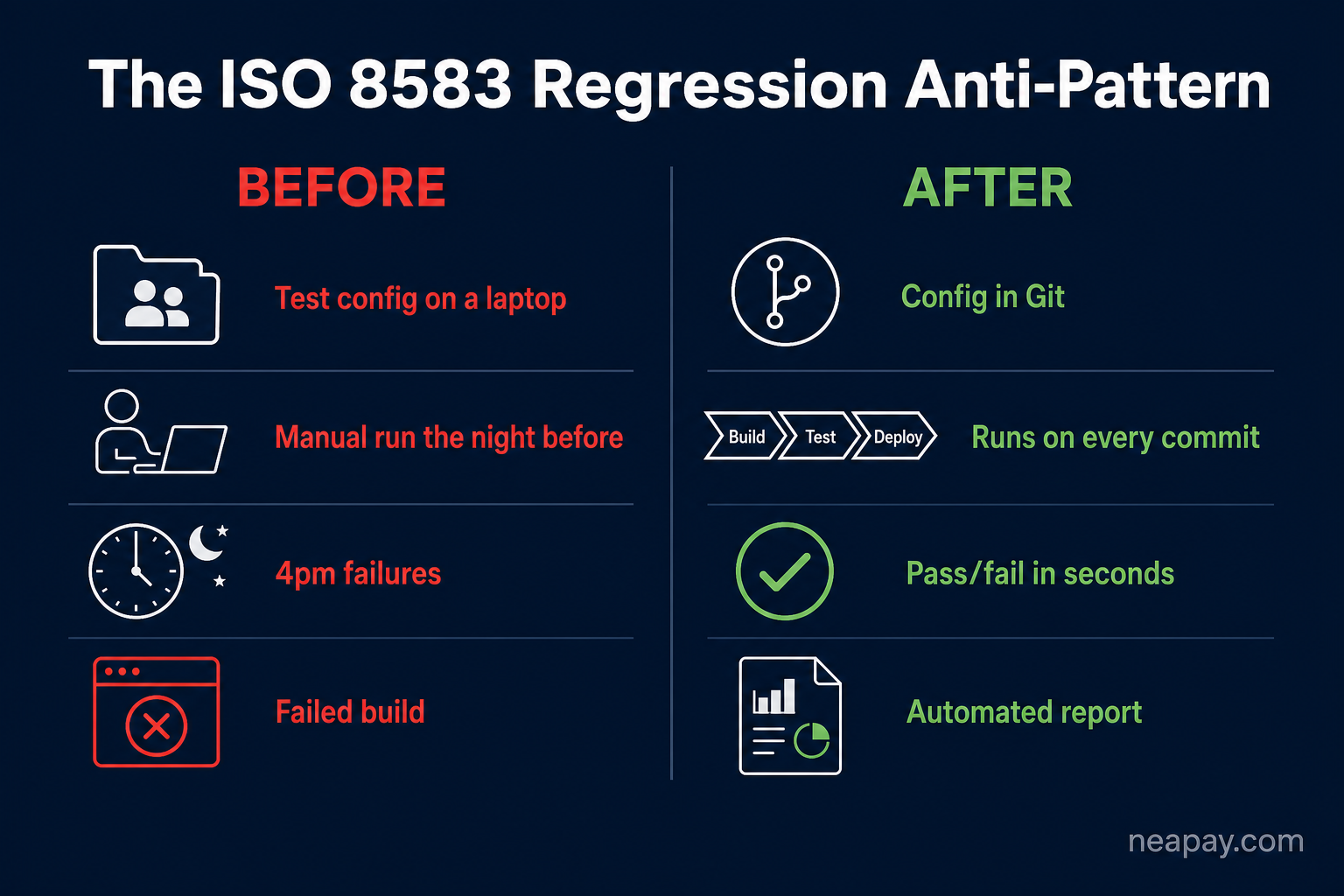
A regression suite that runs manually, on demand, by an engineer who remembers to run it, provides weak protection. Deployments happen under time pressure, and manual steps are skipped under time pressure. The protection the suite provides is only as reliable as the discipline of running it — which is not reliable enough for payment infrastructure.
A regression suite integrated into the CI/CD pipeline runs automatically on every deployment, without requiring any engineer to remember to run it and without any possibility of it being skipped under time pressure. The integration is straightforward: the suite is a test step in the deployment pipeline that runs after the build and before the deployment to production. If the suite passes, the deployment proceeds. If it fails, the deployment is blocked and the engineer is notified of the specific test cases that failed.
This integration requires the simulator to be available in the CI/CD environment — either deployed as a service that the pipeline can reach, or started as a container in the pipeline's execution environment for the duration of the test step. Both approaches are practical with the neaPay simulator. The simulator can run as a persistent service in a staging environment, or it can be started from a Docker image as part of the pipeline step and stopped after the test run completes.
The pipeline integration also requires the test suite to run within a time budget that the pipeline can accommodate. A suite that takes thirty minutes to run will slow the deployment pipeline to a degree that creates pressure to skip it. A suite that runs in five minutes is fast enough to be a standard pipeline step that nobody objects to including. Keeping the suite within a five to ten minute runtime is a design constraint that should inform decisions about how many test cases to include and how they are parallelized.
For suites that grow large enough that serial execution exceeds the time budget, the test cases can be parallelized: multiple test runners executing different subsets of the suite simultaneously against the same simulator instance. The neaPay simulator handles concurrent connections correctly — it is designed for this usage pattern — and parallel execution can typically reduce a twenty-minute serial suite to a five-minute parallel one without any changes to the test cases themselves.
The Simulator Configuration That Regression Testing Requires
Running regression tests against the simulator requires the simulator to be configured differently from its development or certification preparation usage. In development, the simulator is configured to help the team explore and debug specific scenarios. For regression testing, it must be configured to return deterministic, consistent responses for defined inputs — the same input must always produce the same output, so that a test case that passes today will pass next week if nothing has changed, and fail next week if something has broken.
Deterministic scenario configuration. Each test case's card number and transaction parameters are configured in the simulator to produce a specific response. This configuration must be stable — it must not change unless the test case specification itself changes. Managing the simulator's regression testing configuration in version control, alongside the test cases, ensures that changes to the configuration are tracked and reviewed like any other code change.
Isolation between test cases. Test cases that run concurrently must not interfere with each other. If two test cases use the same card number but expect different responses — which can happen if the same card number is used in multiple test cases for different amounts or transaction types — the simulator configuration must use distinct card numbers for each test case, or use a matching condition that distinguishes between the two test cases based on additional parameters.
Network management sequence support. The regression suite should include test cases for the network management message flows — echo request and response, sign-on and sign-off — that are part of the certification requirements. The simulator must be configured to respond correctly to these messages, and the test runner must include the network management sequence in the test execution, not just the authorization and reversal flows.
Failure scenario configuration. The regression suite should include test cases for failure scenarios: timeout handling, connection drop recovery, reversal construction after a timeout. These test cases require the simulator to be configured to produce the failure condition — a delayed response, a dropped connection — for the specific card number or transaction parameters used in the test case. The neaPay simulator's scenario configuration supports per-card-number response timing and connection behavior, making failure scenario regression testing straightforward.
What Changes When a Regression Test Fails
The value of a regression suite is not just in preventing regressions from reaching production — it is in the speed and precision with which it identifies regressions when they do occur. A regression that is caught by the CI/CD pipeline is caught at the point of the change that caused it, by the engineer who made the change, with full context about what changed. A regression that reaches production is caught by a customer, a reconciliation process, or a scheme compliance review, without any context about what caused it and with significant effort required to trace it back to the originating change.
When a regression test fails in the pipeline, the failure report identifies the specific test case that failed, the specific message exchange that produced the unexpected result, and the specific field values that diverged from expectations. The engineer who made the change reviews the failure report, identifies whether the regression is an unintended consequence of the change or an expected behavior change that requires the test case to be updated, and acts accordingly.
If the regression is unintended — the change broke something it should not have — the fix is made before the deployment proceeds. The test case that caught the regression becomes part of the permanent regression coverage for that scenario. The production system never sees the broken behavior.
If the behavior change is intentional — the change deliberately modifies a message flow in a way that changes the expected result — the test case is updated to reflect the new expected behavior, with a review process that confirms the change was intentional and that the new behavior is correct. This review process prevents test cases from being updated to accommodate bugs under the guise of intentional changes.
The Long-Term Compounding Effect
A regression suite for payment infrastructure has a compounding value that is not obvious at the start but becomes significant over time. Each test case added to the suite is a permanent addition to the integration's safety net. Each bug fixed and captured as a test case is a bug that can never silently reintroduce itself. Each certification requirement encoded as a test case is a compliance check that runs on every deployment, forever.
After two years of operating a payment integration with a maintained regression suite, the suite reflects the integration's complete history of certification requirements, production patterns, and discovered bugs. It is a comprehensive, automatically executed specification of how the integration should behave — not a document, but a running validation.
The team that reaches this point does not need a dedicated payments QA function to maintain that specification. The specification maintains itself, because every change that affects the integration's behavior either updates the specification intentionally or is caught by the specification and rejected. The engineering team that operates the integration is the team that maintains the suite, because adding a test case for a fixed bug is the last step of fixing a bug — not a separate QA activity.
This is the correct model for payment infrastructure testing at the scale of most organizations: not a specialized QA function layered on top of the engineering team, but a test suite that is owned by the engineering team, grows with the integration, and runs automatically on every deployment. The simulator makes this model practical, because it provides the always-available, fully controllable, diagnostically rich test target that the suite requires to run reliably in a CI/CD pipeline.
Ready to build a regression suite for your payment integration? neaPay engineers can help you structure the suite — starting with your certification test cases, mapping your production transaction patterns, and defining the failure scenario coverage that gives you real protection rather than false confidence. The simulator configuration that supports automated regression testing can be deployed in your CI/CD environment in a day. Reach out with your current integration scope and your deployment pipeline; the suite design conversation takes an afternoon.