ISO8583 Simulator as a Service: How to Give Your Client a Test Environment Without DevOps Overhead
Category: ISO8583 Simulator Target reader: CTO, Tech Architect, Payments Consultant Keywords: ISO8583 simulator SaaS, payment testing cloud, ISO8583 test as a service, hosted payment simulator, ISO8583 cloud testing environment
Every payment integration project eventually arrives at the same infrastructure question: where does the test environment live, and who is responsible for keeping it running?
For consultants delivering a project to a client, the question has an additional dimension: the test environment needs to be accessible to both the consultant's team and the client's team, it needs to be available continuously throughout the engagement, it needs to be isolated enough that one team's testing activity does not interfere with the other's, and it needs to be set up quickly enough that it is ready before the project's development phase begins rather than becoming the first obstacle to it.
For internal teams at fintechs or banks building payment infrastructure, the question is whether the simulator needs to join the organization's infrastructure management inventory — another service to deploy, monitor, patch, and maintain — or whether it can be consumed as a managed service that is simply available when the team needs it, without requiring anyone to own its operational health.
Both of these are versions of the same underlying question: what is the right deployment model for an ISO8583 simulator, and what does each model require from the teams that use it?
This article examines the deployment options for the neaPay ISO8583 Simulator — on-premise, cloud-deployed, and hosted as a service — explains what each option requires from your team and what it provides in return, and makes the case for when the hosted service model is the right choice and when on-premise or cloud-deployed is more appropriate.
The Three Deployment Models
Before examining the tradeoffs, it helps to define precisely what each deployment model means in the context of an ISO8583 simulator.
On-premise deployment means the simulator runs on infrastructure that your organization owns and operates: physical servers in your data center, VMs in your private cloud, or containers in your on-premise Kubernetes cluster. Your team provisions the infrastructure, installs the simulator, configures it, and is responsible for its availability, its updates, and its integration with your existing monitoring and logging infrastructure. The simulator is entirely within your security perimeter, accessible only from your internal network.
Cloud-deployed means the simulator runs on infrastructure in a public cloud provider — AWS, Azure, GCP — that your organization rents and manages. Your team provisions the cloud instances or containers, installs the simulator, manages the network configuration that makes it accessible to your application and CI/CD environments, and is responsible for cloud resource costs, availability monitoring, and updates. The simulator runs in your cloud account, under your security controls, but the infrastructure management is somewhat lighter than on-premise because the cloud provider handles the physical infrastructure layer.
Hosted as a service means the simulator is managed and operated by neaPay, accessible to your team over the network through a defined interface, without any infrastructure management responsibility on your side. You configure the simulator — dialect profiles, scenario configurations — through a management interface, and the simulator is available at a defined endpoint whenever your team needs it. neaPay is responsible for the simulator's availability, its updates, and its infrastructure health. Your team is responsible only for the configuration that defines the simulator's behavior for your specific integration.
Each model has a different profile of what it requires from your team and what it provides in return.
What On-Premise Deployment Actually Requires
On-premise deployment of the neaPay simulator is the right choice for organizations with strict data residency requirements, regulatory constraints that prohibit sensitive data from leaving the organization's own infrastructure, or security policies that require all test systems to be within the internal network perimeter.
The requirements it places on your team are real and should be understood before choosing this model.
Infrastructure provisioning. The simulator needs a host: a physical server, a VM, or a container runtime. The host needs adequate CPU and memory for the transaction volumes the simulator will handle — for functional testing, modest resources are sufficient; for performance testing at high TPS, more substantial resources are needed. Your infrastructure team provisions this host as part of the simulator deployment, which means the simulator joins the inventory of infrastructure your team manages.
Network configuration. The simulator needs to be reachable from the systems that will connect to it: the integration under test, the CI/CD pipeline that runs the regression suite, the developer workstations used for development testing. Configuring the network access — firewall rules, DNS entries, port exposure — requires involvement from your network team and must be maintained as your network topology changes.
Installation and updates. The simulator is a Java process that runs on a Linux host. Installation is straightforward — deploy the JAR, configure the properties files, start the process — but it requires someone who knows how to do it, and updates require repeating the installation process when new versions are released. If your organization has a formal change management process for software deployments, simulator updates go through that process.
Monitoring and availability. If the simulator goes down — the host crashes, the process exits unexpectedly, a disk fills — your team is responsible for detecting and resolving the issue. If the simulator is part of a CI/CD pipeline that runs automatically, an undetected simulator outage will produce pipeline failures that may be misdiagnosed as integration code issues rather than test infrastructure issues. Monitoring the simulator's availability requires either integrating it into your existing monitoring infrastructure or establishing a dedicated availability check.
Security maintenance. The host running the simulator requires the same security maintenance as any server in your infrastructure: OS patches, vulnerability scanning, access control review. If the simulator handles sensitive test data — test card numbers that resemble real card numbers — the host may need to be treated as in-scope for your security review processes.
These requirements are manageable for organizations with established infrastructure management practices. They are a meaningful overhead for small teams, startup environments, or consulting engagements where infrastructure management is not a core capability.
What Cloud Deployment Adds and Removes
Cloud deployment retains most of the control properties of on-premise deployment — the simulator runs in your cloud account, under your security controls, with your data residency guarantees — while reducing the physical infrastructure management burden.
The cloud provider handles the physical layer: hardware provisioning, data center operations, network backbone. Your team handles the cloud layer: instance provisioning, security group configuration, cloud cost management, and the same installation, update, and monitoring responsibilities that on-premise deployment requires.
For organizations already operating significant cloud infrastructure, adding the simulator to an existing cloud deployment is a modest additional overhead — a new instance or container in an environment that is already managed, monitored, and secured. The marginal cost of managing one more service is low when the management practices are already established.
For organizations that are not primarily cloud infrastructure operators — consulting firms, small fintechs, teams whose core competency is payment software rather than cloud infrastructure — cloud deployment of the simulator adds infrastructure management responsibilities that are not central to the team's work. The simulator needs to be sized correctly for the expected load, scaled when performance testing requirements exceed the initial sizing, monitored for availability, and updated when new versions are released. None of this is difficult, but all of it is overhead that the team must absorb.
What the Hosted Service Model Provides
The hosted service model eliminates the infrastructure management overhead entirely. neaPay operates the simulator as a service — provisioning, monitoring, updating, and maintaining the infrastructure — and provides your team with access to a configured simulator endpoint that is available whenever you need it.
From your team's perspective, the hosted simulator is an endpoint: a TCP address and port that accepts ISO8583 messages and returns configured responses. Your team configures the simulator's behavior — dialect profiles, scenario responses, failure simulation parameters — through a management interface. The configuration is persisted and applied to the simulator immediately, without any deployment or restart process on your side. When a configured scenario needs to be changed, the change is made in the management interface and takes effect within seconds.
The operational responsibilities that on-premise and cloud deployment place on your team are absent in the hosted model:
There is no infrastructure to provision. The simulator is already running, on infrastructure that neaPay manages.
There is no network configuration to manage. The simulator endpoint is already defined and accessible from the network addresses you specify during onboarding.
There is no installation or update process. New versions of the simulator are deployed by neaPay, with changes communicated in advance and applied in a way that does not interrupt your testing.
There is no availability monitoring to set up. neaPay monitors the simulator's availability and addresses issues before they affect your testing. SLA commitments define the availability level your team can rely on.
There is no security maintenance for the simulator infrastructure. neaPay is responsible for the security of the infrastructure layer; your team is responsible only for the security of your configuration and credentials.
What the hosted model requires from your team is minimal: defining the simulator configuration that reflects your integration's requirements, managing the credentials that authenticate your team's access to the simulator, and ensuring that the network path from your development and CI/CD environments to the simulator endpoint is open and functional.
The Consulting Engagement Case for the Hosted Model
For consultants and system integrators, the hosted service model resolves a specific problem that on-premise and cloud deployment do not: the need to provide a test environment to a client whose infrastructure the consultant does not control and whose DevOps capability may be limited.
In a consulting engagement, the test environment needs to be available to both the consultant's team — for development and debugging — and the client's team — for their own development work against the new payment infrastructure. In an on-premise deployment, the simulator runs in one party's infrastructure and the other party accesses it over a network connection that must be configured and maintained. In a cloud deployment, someone must own the cloud account where the simulator runs, pay for the cloud resources, and manage the access controls that determine who can reach the simulator endpoint.
Neither option is clean. The consultant who deploys the simulator in their own infrastructure creates a dependency: if the consultant's infrastructure has issues, the client's development work is blocked. The consultant who deploys the simulator in the client's infrastructure requires the client to have the DevOps capability to support that deployment, which many clients — particularly those engaging a consultant precisely because they lack in-house technical capability — do not have.
The hosted model resolves this by making the simulator a service that neither party needs to operate. The consultant provisions a simulator instance through neaPay's service, configures it with the project's dialect profiles and scenario configurations, and gives both their own team and the client's team access to the endpoint. Both teams can run tests against the simulator simultaneously, with isolation between test sessions managed by the service rather than by either party's infrastructure. When the engagement ends, the simulator instance can be transferred to the client's account — with its configuration intact — so the client continues to have access to the test environment after the consultant has departed.
This handover is clean in a way that on-premise handovers are not. The client receives access to a configured, maintained service — not a server that they now need to manage, patch, and monitor. The institutional knowledge of the simulator's configuration is in the configuration itself — accessible through the management interface — not in the consultant's head or in a deployment runbook that the client may not fully understand.
The CI/CD Integration Case
For internal engineering teams integrating the simulator into a CI/CD pipeline, the deployment model choice affects the reliability and simplicity of the pipeline integration.
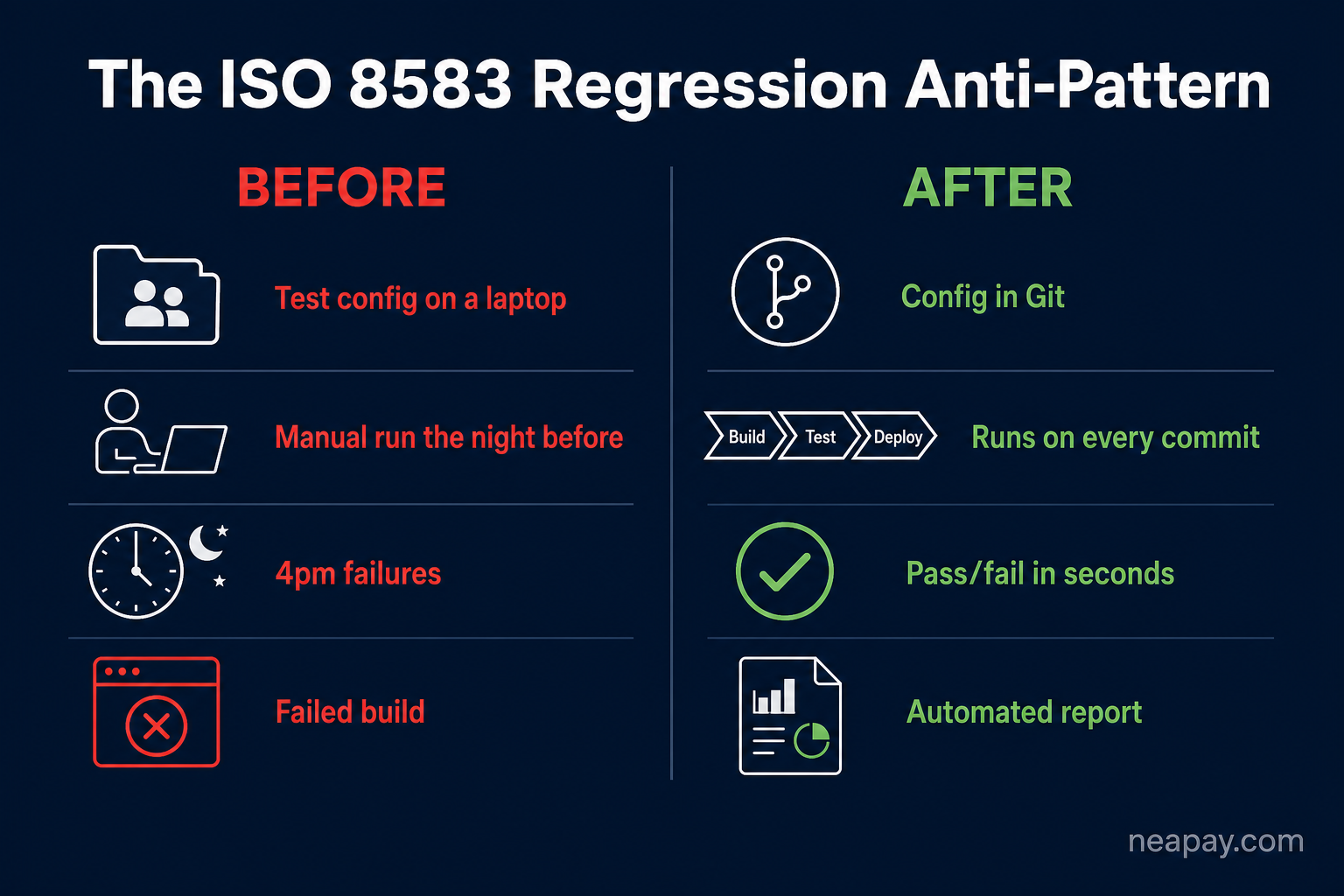
A simulator that runs in the CI/CD environment — started as a container at the beginning of a pipeline run and stopped at the end — provides maximum isolation: each pipeline run gets a fresh simulator instance, with no state carried over from previous runs. This approach works well for functional regression testing where test isolation is important. It requires the CI/CD environment to support container execution and requires the simulator container image to be maintained and updated as new versions are released.
A simulator that runs as a persistent service — either on-premise, cloud-deployed, or hosted — provides a stable endpoint that the pipeline connects to for each run. This approach is simpler to configure in the pipeline: the endpoint address is a fixed configuration variable, and the pipeline step is a standard integration test step that connects to the endpoint, runs the test suite, and reports results. It does not require container execution capability in the CI/CD environment. The tradeoff is that the persistent simulator must be configured correctly and available reliably for the pipeline to function — a requirement that the hosted model satisfies without any management overhead from the team.
For teams whose CI/CD infrastructure is mature and whose DevOps practices include container management as a standard capability, the container-per-run approach is operationally comfortable. For teams whose CI/CD infrastructure is simpler — a managed CI service like GitHub Actions or CircleCI, without a container orchestration layer — the persistent endpoint approach, and therefore the hosted service model, is considerably simpler to implement and maintain.
Multi-Project and Multi-Team Scenarios
Organizations running multiple payment integration projects simultaneously — or organizations with multiple teams that each need access to a simulator — face a configuration management challenge that the hosted model addresses more cleanly than self-managed deployments.
In a self-managed deployment, each project or team typically needs its own simulator instance: a separate process with a separate configuration, running on separate infrastructure or at least a separate port. Managing multiple simulator instances — provisioning them, keeping them updated, monitoring their availability, managing access controls — requires coordination across infrastructure, security, and project teams that adds overhead proportional to the number of instances.
In the hosted model, multiple simulator instances are provisioned through the management interface, each with its own configuration and its own access controls, all managed by neaPay's infrastructure. Adding a new instance for a new project takes minutes. Retiring an instance when a project ends takes seconds. Access credentials are managed per-instance, so each team has access only to the instances relevant to their work.
For organizations at the scale where multiple simultaneous payment integration projects are the norm — large payment facilitators, acquiring banks, payment technology firms — this multi-instance management capability is not a convenience. It is a meaningful operational simplification that reduces the DevOps overhead of payment infrastructure testing across the organization.
The Data Handling Consideration
One concern that arises with hosted test environments is data handling: if the simulator is processing test transactions that include card numbers — even test card numbers — what data protection obligations apply, and how does the hosted model satisfy them?
The answer requires distinguishing between test card numbers and real card numbers. ISO8583 testing uses specific test card numbers — ranges defined by the schemes for testing purposes, such as Visa's 4111111111111111 or Mastercard's 5500005555555559 — that are not real card numbers and do not correspond to real cardholder accounts. These numbers are public test values; their presence in a test environment does not create cardholder data exposure.
The neaPay hosted simulator is configured to work with test card numbers, not real card numbers. Test transactions submitted to the hosted simulator carry test card numbers that have no connection to real cardholder data. The data handling obligations that apply to real cardholder data — PCI-DSS, GDPR in the cardholder data context, local data protection regulations — do not apply to test data that uses scheme-defined test card numbers.
For organizations whose testing processes use real card numbers — which should not be the case, but occasionally occurs when real transaction data is used for testing rather than synthetic test data — the hosted model is not appropriate. Those organizations should use on-premise deployment within their own security perimeter, where real card numbers can be handled under their existing data protection controls. The correct resolution, however, is not to choose a deployment model that accommodates real card numbers in test environments — it is to replace real card numbers with test card numbers or synthetic data, which is the correct practice regardless of deployment model.
Choosing the Right Model for Your Situation
The deployment model decision is not a binary choice between hosted and self-managed. It is a matching exercise between your team's capabilities, your project's requirements, and the properties of each model.
Choose on-premise deployment if your regulatory environment requires all test systems to be within your own infrastructure perimeter, your organization has strong DevOps practices and prefers to operate all infrastructure internally, or your integration requires testing with data that cannot leave your security perimeter.
Choose cloud deployment if you already operate significant cloud infrastructure and have established practices for managing cloud services, you need the control properties of self-managed deployment but prefer cloud economics and elasticity over on-premise hardware, and your team is comfortable with cloud infrastructure management as a standard operational responsibility.
Choose the hosted service if you want the simulator available immediately without infrastructure setup, your team's core competency is payment software rather than infrastructure management, you are a consultant or system integrator who needs to provide a test environment to a client without requiring the client to have DevOps capability, you are running multiple simultaneous projects that each need their own simulator instance, or your CI/CD environment is a managed service that is simpler to integrate with a persistent endpoint than with a self-managed container.
Most teams reading this article are in the hosted service category. The situations that require on-premise or cloud deployment are the exceptions — specific regulatory constraints, specific data handling requirements, or specific organizational preferences for infrastructure self-management. The default, for a team whose goal is to test a payment integration rather than to operate test infrastructure, is the model that requires the least infrastructure management overhead: the hosted service.
The Client Conversation
For consultants who are introducing the simulator to clients who have not encountered it before, the hosted service model simplifies the client conversation considerably.
An on-premise or cloud deployment requires the client to understand what the simulator is, why it needs to run somewhere, how it will be deployed in their infrastructure, who will be responsible for it, and how it will be handed over at the end of the engagement. These are legitimate questions, and answering them takes time and sometimes requires navigating the client's internal infrastructure approval processes.
A hosted service requires the client to understand only that there will be a test environment available immediately, that their team can connect to it from their development environment, and that it will be configured to simulate the acquiring host they are integrating with. The infrastructure details are not the client's concern because the client has no infrastructure to manage. The approval process is not the client's concern because no client infrastructure is being modified.
This simplification is not just a time-saver at the start of the engagement. It removes a category of project risk — client infrastructure approval delays, client DevOps capacity constraints, client security review requirements for new infrastructure — that has nothing to do with the payment integration itself but that can delay the project's start just as effectively as any technical obstacle.
The hosted simulator starts the engagement with a test environment that is ready before the client has had to approve anything. That is the correct starting position for a payment integration project.
Ready to provision a hosted ISO8583 simulator for your next project? neaPay's hosted simulator service can be provisioned with your dialect profile and scenario configuration within a day of request — no infrastructure setup, no DevOps overhead, no waiting. Reach out with your scheme, your acquirer, and your go-live timeline, and the test environment will be ready before your development phase begins.