ISO8583 Simulator vs a Real Test Environment: The Hidden Costs of Waiting on the Scheme
Category: ISO8583 Simulator Target reader: CTO, Tech Architect, Payments Consultant Keywords: ISO8583 test environment, card scheme sandbox alternative, ISO8583 simulator on-premise, payment testing independence, Visa test environment alternative
There is a moment in almost every payment integration project where the team finishes the first substantial piece of implementation work and needs to test it. The connection management layer is built. The first message type is implemented. The field mappings are defined. The code is ready to exercise against something real.
The natural instinct is to request access to the scheme's test environment — the sandbox, the certification environment, the host simulator provided by the acquiring bank. This is what test environments are for. You build something, you point it at the test environment, you see if it works.
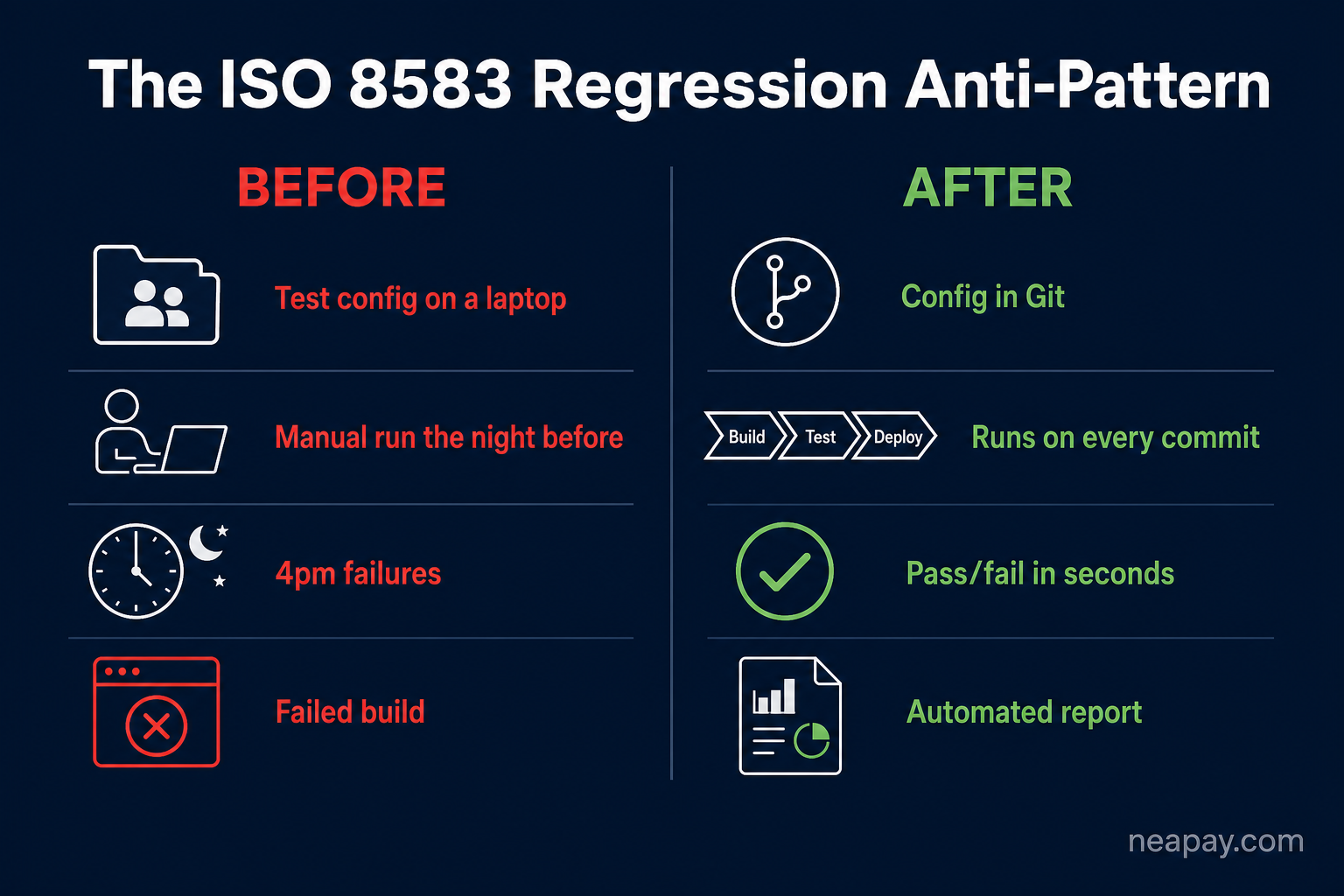
What follows, in the experience of most teams encountering this for the first time, is a wait. Access to the scheme's test environment requires a formal request. The request requires paperwork — an integration agreement, a technical onboarding form, sometimes a commercial engagement with the acquiring bank that precedes any technical access. Processing takes time: one week, two weeks, sometimes four. While the team waits, the implementation work that was ready to test sits untested. Engineers move on to other tasks, lose context, and have to re-orient when the credentials finally arrive.
When the credentials arrive, the test environment turns out to have constraints that were not described in the onboarding documentation. It is available during defined hours. It has a limited set of test card numbers that produce predictable responses. It does not support the failure scenario testing that the integration needs. Performance testing against it is prohibited. And when something goes wrong — when a message is rejected and the team does not understand why — the diagnostic information available from the environment is a rejection code, not a field-level trace.
This is the hidden cost of depending on scheme-provided test environments as the primary development and testing infrastructure. It is not that they are useless — they serve a specific purpose, and that purpose is valuable. It is that they are designed for formal certification validation, not for the iterative development and comprehensive testing that a payment integration requires before certification is appropriate.
This article examines the hidden costs of scheme test environment dependency in detail, explains what those costs mean for project timelines and team productivity, and makes the case that an on-premise or cloud-deployed simulator is not an alternative to the scheme's test environment — it is the complement that makes the scheme's test environment useful rather than frustrating.
The Access Delay Cost: Weeks of Productivity Lost Before Testing Begins
The first and most immediate hidden cost of scheme test environment dependency is the access delay: the time between when your team is ready to test and when they can test.
Card scheme test environments are not public infrastructure. They are controlled resources that require formal engagement to access. The engagement process varies by scheme and by the acquiring bank that sponsors your access, but it consistently involves steps that take time regardless of how quickly your team moves: submitting an application, executing a technical participation agreement, completing a security questionnaire, receiving credentials through a formal provisioning process, and in some cases attending an onboarding call with the scheme's technical team.
For Visa and Mastercard specifically, the typical access timeline for a new integration partner ranges from two to six weeks from initial request to usable credentials. For domestic schemes where access is managed by a local acquiring bank rather than the scheme directly, the timeline can be longer, particularly in markets where the bank's technical team handles integration onboarding alongside their other operational responsibilities.
This delay is not a one-time cost. It is a recurring cost for every new acquirer relationship, every new scheme, and every new test environment instance that the project requires. A project integrating with two acquirers on two schemes may need to navigate four separate access request processes, each with its own timeline and its own dependencies.
The productivity cost of this delay is not just the calendar time. It is the engineering momentum cost: the team that was ready to test and had to stop loses context. The bugs that would have been found in week two are not found until week six or eight, when the team has moved on to other work and must re-engage with code they have not touched for a month. The feedback loop that was disrupted by the access wait does not fully recover until the team has been working in the test environment long enough to rebuild their testing rhythm.
A simulator deployed in your own environment has no access delay. It is available the same day it is deployed — which, for the neaPay simulator, is typically within hours of the deployment decision. The team that finishes implementing the first message type can test it the same afternoon. The feedback loop operates from day one.
The Availability Cost: Testing Only When the Environment Is Open
Scheme test environments are not available continuously. They have defined availability windows — typically business hours in the scheme's time zone — and they have planned maintenance periods that take them offline, sometimes with advance notice and sometimes without.
The availability constraint is a productivity tax on every engineer who works outside the scheme's business hours, which in a globally distributed team or a startup culture where engineers work nonstandard hours is a significant portion of the development week. An engineer debugging a message construction issue at 7pm cannot test a fix against the scheme's test environment until the following morning. A team in a time zone eight hours offset from the scheme's headquarters loses most of the overlap between their working hours and the environment's availability window.
Unplanned outages add unpredictability on top of the scheduled unavailability. A test session that was planned to validate a reversal flow implementation is cancelled when the scheme's test environment goes down unexpectedly. The team loses the session, reschedules for the next available window, and loses a day of validation work.
The cumulative effect of these availability constraints is that the number of useful testing hours available to the team in a given week is substantially lower than the team's working hours in that week. A team working forty hours may have access to the test environment for twenty of those hours, and actual useful testing time — accounting for environment latency, test setup, and diagnostic work — may be considerably less.
A simulator deployed in your environment is available continuously. It does not have business hours. It does not have maintenance windows that are outside your control. It does not go down when a scheme's infrastructure team performs an unrelated update. Testing happens when your engineers are ready to test, not when the scheme's infrastructure is available.
The Diagnostic Opacity Cost: Understanding Failures Takes Weeks, Not Hours
When an ISO8583 message is rejected by a real scheme test environment, the response is typically a rejection code and a short description. "Field 55 encoding error." "Invalid message type." "Missing mandatory field." The code and description identify what was wrong. They do not tell you where in the field the encoding error is, which mandatory field is missing, or why the message type is considered invalid for this specific transaction scenario.
Diagnosing the root cause of a rejection in a real scheme test environment requires working backward from a terse error message to the specific implementation issue that produced it. This is tractable when you have deep ISO8583 experience and can quickly map "field 55 encoding error" to the specific BER-TLV tag that is incorrectly encoded. It is slow and frustrating when you are building your first ISO8583 integration and the error message does not contain enough information to distinguish between ten possible causes.
The diagnostic gap between knowing what failed and knowing why it failed is typically bridged by one of two mechanisms: internal debugging, which requires the ability to inspect the raw bytes of the message that was sent and compare them against the scheme's field specification; or external support, which means opening a ticket with the scheme's technical support team and waiting for a response.
Internal debugging against a real scheme environment is limited by the fact that the environment does not return the raw message that was rejected or a field-by-field validation report. It returns a response code. Recreating the sent message and inspecting it requires either detailed logging in the integration's own code — which may or may not have been implemented — or sending the same message again and capturing it with a network trace tool.
External support, as discussed in earlier articles, operates on a timeline measured in days rather than hours. A support ticket opened on Monday may receive a response on Wednesday or Thursday. If the first response does not resolve the ambiguity — which is common when the question requires back-and-forth clarification — the total diagnostic cycle may span a week or more for a single rejection.
In a project with forty diagnostic cycles — each integration issue that requires a support ticket — the total time spent waiting for diagnostic information approaches the duration of the project itself. This is not an exaggeration. Teams that rely exclusively on real scheme environments for development testing report that support ticket cycles are among the most significant contributors to project delay.
The neaPay simulator's diagnostic approach is opposite to this. Every message exchange is logged at the field level: the raw message bytes, the parsed field values, the validation result for each field against the configured field specification, and the response with the reason for any validation failure expressed in field-specific terms. When a field encoding error occurs, the simulator's log identifies the specific field, the expected encoding, the actual encoding, and the byte position where they diverge. The diagnosis that takes days with a real scheme environment takes minutes with the simulator.
The Scenario Coverage Cost: Testing Only What the Scheme Allows
Real scheme test environments provide a defined set of test card numbers, each associated with a specific response behavior. You submit a transaction with test card number A and receive an approval. You submit with test card number B and receive a decline with response code 05. You submit with test card number C and receive a referral. The set of test cards covers the response scenarios that the scheme has chosen to include in their test data set — which is the set of scenarios relevant to formal certification, not necessarily the set of scenarios your integration needs to test.
The scenarios that are most important for production reliability — failure conditions, edge cases, unusual message sequences — are typically not represented in the scheme's standard test card set. A test card that produces a response timeout does not exist in most scheme test environments, because the scheme's test environment is not designed to simulate its own unavailability. A test card that produces a partial approval for a specific amount may or may not be available depending on the scheme and the integration type. A test card that produces a specific sequence — approval followed by a delayed reversal response — requires the scheme's test environment to implement specific timing behavior that most test environments do not support.
The consequence is that scenario coverage against a real scheme test environment is structurally limited to the scenarios the scheme has chosen to make testable. The scenarios outside that set — which are often the most important for production reliability — are untestable against the scheme's environment by design, not by oversight.
A simulator provides unrestricted scenario coverage. Any card number can be configured to produce any response behavior. Any response can be delayed by any duration. Any connection can be made to drop at any point. Any field can be returned with an invalid encoding. The scenario space is bounded only by what the integration needs to test, not by what the scheme has chosen to include in its test data.
This unrestricted scenario coverage is what makes the simulator indispensable for the failure scenario testing described in article 13 — and it is what makes the simulator irreplaceable by any real scheme test environment, regardless of how good that environment is for its intended purpose.
The Performance Testing Cost: No Load Testing Allowed
Scheme test environments explicitly prohibit performance testing. The terms of use for most scheme test environments include a prohibition on submitting transaction volume above a defined threshold — typically a low threshold, measured in transactions per minute rather than transactions per second — and treat high-volume submission as a misuse of the environment that can result in revoked access.
This prohibition is reasonable from the scheme's perspective. Their test environment is shared infrastructure that serves many integration partners simultaneously. A single partner running a load test at 500 TPS would affect the environment's availability for every other partner using it at the same time.
From your team's perspective, it means that the only question you cannot answer before go-live using a real scheme test environment is the question that most directly affects production reliability: does the integration perform correctly at production transaction volume?
The performance gaps that matter — connection pool contention under concurrent message load, routing rule evaluation latency at high TPS, transaction logging write throughput during peak traffic — are invisible in testing at the low volume the scheme's environment permits. They become visible only under the load that production generates, at which point addressing them requires a production incident response rather than a controlled engineering fix.
A simulator deployed in your own environment has no volume restrictions. You can submit 10 TPS, 100 TPS, or 1000 TPS against it. You can run sustained load tests that last hours, measuring response time distributions, error rates, and system resource utilization under realistic conditions. You can identify the performance bottlenecks in your integration before they become production incidents, and you can fix them before any real transaction is processed.
The Cost Comparison: Simulator vs Scheme Environment Dependency
The costs described above — access delay, availability constraints, diagnostic opacity, limited scenario coverage, and no performance testing — are individually significant and collectively substantial. But they are costs that do not appear on any budget line, because they are not direct financial costs. They are time costs, productivity costs, and risk costs, which makes them easy to underestimate and easy to accept as unavoidable.
They are not unavoidable. They are the specific costs of a specific architectural choice: the choice to use scheme-provided test environments as primary development infrastructure rather than as their intended purpose of formal certification validation.
The alternative architecture — simulator for development, real scheme environment for certification — eliminates each of these costs:
The access delay cost disappears because the simulator is available immediately. Testing begins the same day implementation is ready, not weeks later.
The availability cost disappears because the simulator is always on. Testing happens when engineers are ready, not when the scheme's environment is open.
The diagnostic opacity cost disappears because the simulator provides field-level diagnostic detail. Failures are understood in minutes, not diagnosed through support tickets over days.
The scenario coverage cost disappears because the simulator supports any configured scenario. Failure conditions, edge cases, and timing-sensitive sequences are all testable.
The performance testing cost disappears because the simulator has no volume restrictions. Load testing happens before go-live, not after.
The cost of the simulator itself — licensing, deployment, configuration — is a fraction of the engineering time that even one of these costs represents in a typical integration project. The access delay alone, at two to four weeks of delayed testing for a team of three engineers, represents more in lost productivity than the simulator costs for a year.
What the Real Scheme Environment Is Actually For
This article has focused on the limitations of scheme test environments, which could create the impression that they are not valuable. They are valuable — for their intended purpose. That purpose is formal certification validation: demonstrating to the scheme, in their controlled environment, using their defined test cases, that your integration meets their requirements.
For that purpose, the real scheme environment is irreplaceable. The simulator can prepare you for certification. It cannot substitute for the formal certification session itself. The scheme's sign-off on your integration requires demonstrating correct behavior in their environment, not in yours.
The point is not that the scheme's test environment should be avoided. It is that it should be used for what it is designed for — and only for that — while the simulator handles the development, debugging, failure scenario testing, and performance testing that the scheme's environment cannot support.
Used together, the two environments are complementary and complete. The simulator provides the fast, always-available, diagnostically rich development environment that makes building a correct integration efficient. The scheme's environment provides the formal validation that authorizes the integration for live use. Neither can substitute for the other. Both are necessary.
The common failure mode is treating the scheme's environment as the primary test infrastructure — which makes it serve a purpose it was not designed for and incurs all the costs described in this article — while underutilizing or ignoring the simulator that would have made the development process fast and the certification process smooth.
The Independence Question
There is a dimension to the simulator vs scheme environment question that goes beyond project timelines: operational independence.
An integration team that depends on scheme test environments for all testing is dependent on the scheme's infrastructure for its ability to do its job. When the scheme's environment is unavailable — maintenance, outage, access revocation — the team cannot test. When the scheme changes its test environment behavior — new test cards, retired test scenarios, changed response codes — the team must adapt to changes it did not control and did not anticipate.
An integration team that operates its own simulator is independent of these external changes. The simulator is infrastructure the team controls. Its behavior is defined by the team's configuration, not by a third party's decisions. Its availability is managed by the team's infrastructure practices, not by a scheme's maintenance schedule.
This independence compounds over time. As the payment stack grows — more schemes, more acquirers, more integration types — the testing infrastructure grows with it, entirely within the team's control. Adding a new scheme to the simulator's configuration takes hours. Requesting access to a new scheme's test environment takes weeks. The team that built its testing independence on the simulator maintains that independence at scale. The team that built its testing dependency on scheme environments deepens that dependency with each new scheme added.
For fintechs, payment facilitators, and technology companies building payment infrastructure as a core capability, testing independence is a strategic asset. It means the ability to develop, test, and validate payment integrations at the speed the business requires, without being governed by the availability, accessibility, and diagnostic limitations of external infrastructure that was not designed to serve as your primary development environment.
Ready to move your payment integration development off scheme test environment dependency? The neaPay ISO8583 Simulator deploys in your environment — on-premise or cloud — with dialect profiles pre-configured for the schemes you are integrating with and scenario configurations that cover your certification test case requirements from day one. neaPay engineers can help you structure the simulator deployment so that your team has a complete, independent test environment before the first line of integration code is written. Reach out before your project starts — not after the first access request queue.