ISO8583 Switch for Fintechs: How to Go Live With Card Routing in Weeks, Not Quarters
Category: ISO8583 Switch Target reader: CTO, Tech Architect, Payments Consultant Keywords: fintech ISO8583 switch, payment routing go live fast, ISO8583 deployment weeks, card routing fintech, payment switch time to market
Fintech moves at a pace that payment infrastructure was not designed for. A commercial opportunity has a window. A regulatory license has a launch condition attached to it. An investor milestone requires a live payment product by a specific date. A partnership agreement includes a go-live deadline that was negotiated before anyone had a detailed view of the technical work required.
Into this environment lands the requirement for card routing infrastructure: a payment switch that accepts ISO8583 transactions from one or more sources, applies routing rules to determine the correct acquirer, manages the connections to those acquirers, and handles the transaction lifecycle end to end. The business knows it needs this. The question that determines whether the launch date is met or missed is how long it takes to have it working in production.
The honest answer, for a team building a custom switch from scratch, is quarters — not weeks. The honest answer for a team deploying the neaPay ISO8583 Switch is weeks — not quarters. The gap between those two answers is not a marketing claim. It is the direct consequence of what each approach requires your team to build, test, and certify before a single live transaction can be processed.
This article explains where the time goes in each approach, what specifically makes a pre-built switch deployable in weeks rather than months, and what your team actually needs to do to get from zero to live card routing on a fintech timeline.
The Fintech Timeline Problem Is a Real Problem
Before getting into architecture and deployment, it is worth acknowledging that the timeline pressure fintechs operate under is not irrational impatience. It is a structural feature of how fintech businesses are built and funded.
Fintech companies often have commercial agreements — with banks, with scheme sponsors, with enterprise clients — that include go-live conditions. A Banking-as-a-Service partnership may require a live card program within six months of signing. An acquiring relationship may have a minimum transaction volume commitment that only makes sense if the integration is live within a defined window. A regulatory license may require demonstrating a functioning payment product as part of the ongoing compliance condition.
These deadlines are real and they are not movable by engineering capacity alone. Adding engineers to a payment switch build does not linearly reduce the timeline, because the bottlenecks — certification queues, acquirer technical support response times, scheme test environment availability — are external and do not respond to additional internal resource.
A fintech that misses its go-live deadline does not just experience a delayed launch. It may breach a commercial agreement, trigger a minimum volume penalty, jeopardize a regulatory condition, or lose a market window to a competitor that moved faster. The cost of a delayed payment infrastructure launch is not just the delayed revenue — it is the downstream commercial and regulatory consequences of the delay.
This is the context in which the question of weeks versus quarters needs to be evaluated. It is not an abstract preference for speed. It is a concrete risk that determines business outcomes.
Where the Quarters Go in a Custom Switch Build
A team building a payment switch from scratch for the first time will spend time in five broad areas, each of which takes longer than initial estimates suggest and none of which can be meaningfully parallelized with the others.
Protocol implementation. The switch needs to speak ISO8583 correctly for each acquirer it will connect to. This means implementing TCP connection management, message framing, bitmap construction, field encoding for each data element type, and the echo message handling that keeps connections alive. For a team without prior ISO8583 experience, getting this right — not just working in happy-path testing but correct under all the conditions that production will eventually produce — takes two to three months. For a team with some prior experience, it takes less, but rarely less than six weeks for a production-grade implementation.
Routing engine. The routing logic itself — evaluating a transaction against a rule set and selecting a destination — is not the time-consuming part. The time-consuming part is building the infrastructure around it: the rule evaluation engine that handles BIN ranges, scheme identification, transaction type conditions, and amount thresholds; the configuration management that allows rules to be updated at runtime without restarting the switch; the failover logic that handles acquirer unavailability, in-flight transaction protection, reversal handling, and recovery validation. Building this correctly, as described in the article on failover routing, takes another two to three months.
Acquirer connection management. Each acquirer connection requires its own configuration, its own health monitoring, its own reconnection logic, and its own handling of the specific ISO8583 dialect that acquirer uses. Implementing and testing connection management for multiple acquirers — including the failure scenarios that only reveal themselves under specific network conditions — adds another month to six weeks.
Transaction logging and reconciliation. A production switch needs a reliable transaction log that captures every message event with sufficient detail for settlement reconciliation, dispute resolution, and regulatory audit. Implementing this in a way that is reliable under load, structured for downstream use, and complete across all event types — inbound request, routing decision, outbound message, response, failover event, reversal — is several weeks of work that is easy to underestimate because it sounds like a reporting concern rather than a core switch function.
Certification. Each acquirer relationship requires a technical certification before live transactions can be processed. Certification involves running a defined set of test cases against the acquirer's certification environment, demonstrating correct message construction and response handling across a range of transaction scenarios, and receiving formal sign-off from the acquirer or scheme. The certification process itself — not the preparation, just the process of running test cases and receiving feedback — takes four to eight weeks for a first certification, assuming no significant failures. Failures add time proportional to their severity and to the acquirer's support response time.
Added together and accounting for the realistic sequencing of these workstreams — you cannot certify before the protocol implementation is complete, you cannot test connection management before you have acquirer test credentials, you cannot run certification before you have a working routing engine — the realistic timeline for a first payment switch build by a capable team without prior switch development experience is six to nine months from start to live transactions.
For a fintech with a six-month go-live commitment, that timeline means the switch build needs to start at the same time the commercial agreement is signed, with no time for iteration, no buffer for the discoveries that always emerge during certification, and no capacity to adjust scope without risking the deadline.
What a Pre-Built Switch Changes About That Timeline
The neaPay ISO8583 Switch compresses this timeline not by doing the work faster but by eliminating the work that should not be your team's work in the first place.
The protocol implementation is already done. The TCP connection management, the bitmap construction, the field encoding, the echo message handling — these are implemented in the switch, tested across real-world integration scenarios, and do not require any implementation work from your team. Your team does not write protocol code. They configure acquirer connections.
The routing engine is already done. The rule evaluation logic, the BIN table lookup, the scheme identification, the runtime configuration updates — these are built into the switch. Your team does not implement a routing engine. They define routing rules in the switch's configuration layer.
The connection management infrastructure is already done. The health monitoring, the reconnection logic, the failover state machine, the reversal handling — these are built in. Your team does not build connection management. They configure failover chains.
The transaction logging is already done. The event capture, the log structure, the database or file output — these are configurable in the switch. Your team does not implement a logging system. They point the switch at their log destination.
What remains for your team is the work that is genuinely specific to your environment and your business requirements: defining your acquirer connections, writing your routing rules, testing your specific transaction flows, and completing the certification process for each acquirer.
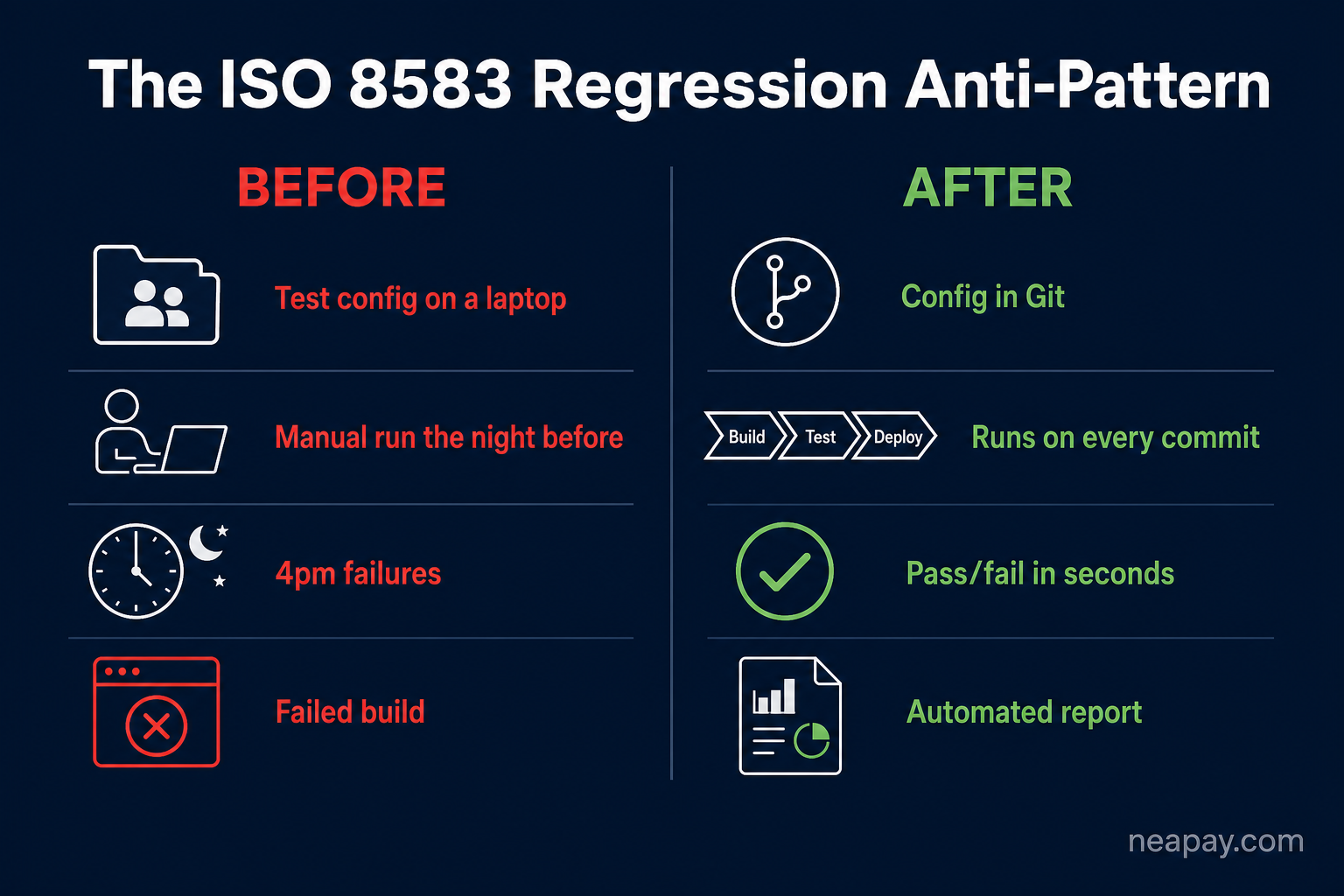
Of these remaining activities, the certification process is the one that cannot be compressed by the quality of the switch — it is an external process with its own timeline. But it can be prepared for more efficiently when the switch's message construction is already correct for the scheme's requirements, and when the neaPay simulator can be used to run through the certification test cases in your own environment before entering the acquirer's certification queue. Teams that use the simulator for pre-certification preparation consistently experience fewer certification failures and shorter overall certification timelines than teams that enter certification with untested implementations.
The realistic timeline for deploying the neaPay switch, completing acquirer configuration, and passing certification for a first acquirer relationship is four to eight weeks — depending on acquirer response times, the complexity of your routing requirements, and your team's familiarity with the switch's configuration layer. For a second acquirer, the timeline is shorter, because the switch infrastructure is already running and the work is limited to the new acquirer's connection configuration and certification.
The Configuration Work Your Team Does
Understanding what your team actually does during a neaPay switch deployment is important for realistic planning, because "configuration rather than development" can sound like it means "no work required." It does not. It means the work is different in character — scoped, bounded, and achievable without protocol expertise — rather than absent.
Acquirer connection configuration. For each acquirer, your team defines the host address, port, connection parameters, echo message interval, and the ISO8583 dialect profile. neaPay provides pre-built dialect profiles for common acquirer configurations — many acquirers your team is likely to work with already have a profile available. Where a custom profile is needed, neaPay engineers provide support in defining it from the acquirer's integration documentation. This work takes hours to days per acquirer, not weeks.
Routing rule definition. Your team writes the routing rules that determine which transactions go to which acquirer. Rules are expressed in a structured configuration format — BIN range conditions, scheme identifiers, transaction type conditions, amount thresholds, and the destination acquirer or failover chain for each rule. For a straightforward multi-acquirer setup — domestic BINs to one acquirer, international BINs to another, with failover chains for each — rule definition is a day's work. For more complex routing requirements, it scales accordingly but remains bounded by the complexity of the business rules, not by protocol implementation complexity.
Routing testing with the simulator. Before connecting to any real acquirer environment, your team tests the routing configuration using the neaPay simulator. The simulator presents a realistic ISO8583 environment against which test transactions can be sent, routing behavior can be validated, and edge cases — failover triggers, reversal flows, partial approval handling — can be exercised. Testing with the simulator typically takes two to five days for a complete routing configuration validation.
Certification preparation and execution. Your team runs through the acquirer's required certification test cases, using the simulator for pre-certification validation and the acquirer's certification environment for formal test execution. neaPay provides documentation mapping the switch's configuration to each common acquirer's certification requirements, reducing the preparation work required from your team. The formal certification process timeline is governed by the acquirer, not by your team or the switch.
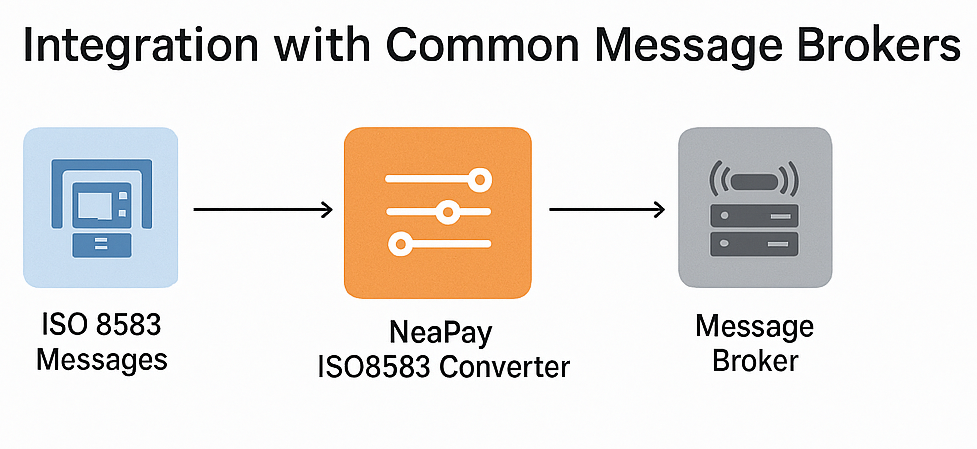
Integration with your application. Your application needs to send ISO8583 transactions to the switch's inbound connection. If your application is already sending ISO8583, this is a connection endpoint change. If your application speaks REST or JSON, neaPay's converter component handles the translation — the switch and converter can be deployed together, with the converter handling the application-facing REST interface and the switch handling the acquirer-facing routing. Integration work is typically one to three days.
This is the complete scope of your team's deployment work. There is no protocol implementation, no connection management development, no routing engine build, no logging system implementation. The work is scoped, sequential, and achievable within a fintech timeline.
The Expertise Your Team Does Not Need
One of the less obvious benefits of a pre-built switch deployment is not just the timeline compression but the expertise compression — the reduction in the specific knowledge your team needs to hold to deploy and operate payment routing infrastructure.
ISO8583 protocol expertise. Your team does not need to understand bitmap construction, field encoding rules, message framing, or TCP connection management for financial messaging. They need to understand the switch's configuration layer, which is documented in plain terms and does not assume protocol knowledge. A backend engineer who has never worked with ISO8583 can configure acquirer connections and routing rules from the switch's documentation without needing to study the ISO8583 specification.
Scheme-specific implementation knowledge. Each card scheme has specific field requirements, message flow variations, and certification test case libraries. Understanding these in depth is necessary for a team implementing scheme support from scratch. For a team configuring a pre-built switch, this knowledge is encapsulated in the switch's dialect profiles and certification preparation documentation. Your team needs to understand your business requirements — which schemes, which transaction types, which markets — not the scheme's technical specifications.
Payment switch design knowledge. Building a reliable payment switch requires understanding of failover state machines, message correlation under load, reversal flow design, and connection pool management. Operating a pre-built switch requires understanding of how to configure these behaviors — thresholds, timeouts, failover chains — not how to implement them. The design knowledge is inside the product. Your team needs operational knowledge of the configuration layer.
This expertise compression matters beyond the initial deployment. It determines how many people in your organization need to understand the payment switch deeply in order for it to be operated safely. For a team building a custom switch, that number is everyone who touches the codebase — typically two to four engineers who carry the institutional knowledge of the implementation. For a team operating a pre-built switch, the knowledge required is bounded by the configuration layer — any engineer who understands the configuration documentation can reason about the switch's behavior.
Fintech-Specific Considerations
Beyond the general benefits of a pre-built switch, there are several considerations specific to the fintech context that affect deployment planning.
BIN sponsorship and scheme membership. Many fintechs access card schemes not through direct scheme membership but through a BIN sponsor — a licensed bank or payment institution that provides access to the scheme under its own membership. BIN sponsorship arrangements often include specific technical requirements imposed by the sponsor: particular message formats, mandatory field inclusions, specific response code handling, reporting interfaces. The neaPay switch's configurable field mapping handles sponsor-specific requirements through configuration rather than code, so adding a sponsor's specific requirements does not require a development cycle.
Regulatory reporting. In many jurisdictions, fintech payment operations are subject to regulatory transaction reporting requirements: specific data elements that must be captured for each transaction, reporting formats that must be submitted to the regulator on a defined schedule, audit trail requirements that govern how long transaction records must be retained and in what form. The switch's transaction logging captures the data elements required for these reports, and the log structure can be configured to output in formats compatible with common regulatory reporting workflows.
Scaling from pilot to production. Fintechs frequently launch payment products with a pilot scope — a limited user base, a restricted transaction volume, a single acquiring relationship — before scaling to full production. A pre-built switch accommodates this pattern without requiring re-architecture at each scale point. The routing configuration scales from one acquirer to several, from simple BIN-based rules to complex multi-condition routing, from a single inbound source to multiple channels, through configuration changes that do not touch the switch's core infrastructure. The switch that handles the pilot is the same switch that handles the production scale.
Time-to-second-market. Once the switch is deployed and the first acquirer is certified, adding a second acquirer is primarily a certification exercise — the switch infrastructure is already running, the routing configuration is already understood by your team, and the new acquirer's connection configuration follows the same pattern as the first. Teams that went through a six-month switch build for the first acquirer typically spend another three to four months on the second. Teams operating a pre-built switch typically complete the second acquirer in three to five weeks, because the infrastructure investment was made once and the incremental work is bounded by the new acquirer's configuration and certification requirements.
The Commercial Question Behind the Technical One
When a fintech evaluates whether to build a custom switch or deploy a pre-built one, the question is sometimes framed as a control question: do we want to own our payment infrastructure or depend on a vendor?
The framing is understandable but slightly off. The relevant question is not ownership versus dependency — it is which dependencies are strategic and which are operational.
A fintech's strategic dependencies are the things that differentiate it: its product design, its customer experience, its commercial model, its regulatory positioning, its data strategy. These are the things worth owning deeply, building carefully, and retaining control over.
A fintech's operational dependencies are the things that need to work reliably as infrastructure. Payment routing is infrastructure. It needs to work correctly, scale with the business, handle failures automatically, and be maintainable by a team that is not entirely composed of protocol specialists. These are the properties that a well-designed pre-built switch provides — and that a custom build provides only after the investment of months and the accumulation of hard-won protocol knowledge.
Owning the custom switch does not make payment routing a strategic asset. It makes it an engineering maintenance commitment that consumes capacity that could otherwise be spent on the things that actually differentiate the business.
The fintech that deploys a pre-built switch and goes live in six weeks is spending its engineering capacity on its product. The one that builds a custom switch and goes live in nine months is spending its engineering capacity on infrastructure. Both eventually have a working payment switch. Only one has nine months of additional product development to show for the same period.
Ready to map your go-live timeline to a realistic switch deployment plan? neaPay engineers can review your acquirer relationships, your routing requirements, your application architecture, and your certification timeline, and give you a concrete deployment plan with realistic week-by-week milestones — not a sales estimate, but an engineering assessment based on your specific situation. Bring your commercial go-live date and your technical requirements; the planning conversation takes an hour.