What CTOs Get Wrong About ISO8583 Integration Timelines
Category: ISO8583 Converter Target reader: CTO, Tech Architect, Payments Consultant Keywords: ISO8583 integration timeline, payment integration estimate, ISO8583 project duration, how long card network integration, ISO8583 fast integration
The estimate comes back from the engineering team: six to eight weeks. It sounds reasonable. ISO8583 is a messaging protocol, the team has built integrations before, and there are libraries available. Six to eight weeks feels like it has margin in it.
Twelve months later, the integration is in production. It took three times longer than estimated, consumed engineering capacity that was meant for product work, and required two rounds of certification remediation with the card scheme. The original estimate was not reckless — it was made by competent people who did not yet know what they did not know.
This is not an unusual story. It is close to the median experience for teams building ISO8583 integrations from scratch for the first time. Understanding why the timelines slip — and what can prevent it — is worth more than any project plan.
Why the First Estimate Is Almost Always Wrong
ISO8583 integration estimates tend to be wrong in a specific direction and for a specific reason: the people making the estimate are excellent engineers who are reasoning by analogy from integrations they have built before.
REST API integrations have a predictable shape. You read the documentation, understand the endpoints, authenticate, map your data to the required fields, handle errors, write tests, and ship. The unknowns are bounded. The feedback loop is fast — you make a call, you get a response, you see immediately whether it worked.
ISO8583 does not have that shape. The feedback loop is slow, the unknowns are not visible upfront, and the failure modes are subtle in ways that do not surface until you are deep into implementation or, worse, into certification testing.
The estimate gets made based on the shape of integrations the team knows. The actual work has a completely different shape. That gap is where the months go.
The Five Timeline Killers Nobody Puts in the Project Plan
1. Learning the protocol takes longer than reading the specification.
ISO8583 has a published standard. Engineers read it, nod, and feel like they understand it. The standard describes the structure: message type indicators, a primary and secondary bitmap indicating which fields are present, and up to 128 data elements with defined types and lengths. That much is graspable in a day.
What the standard does not tell you is how your specific acquiring host, scheme, or payment network has implemented it. Every ISO8583 deployment in the wild is a dialect. Your host may use HISO87 or HISO93 variants. It may have custom field definitions in the private-use data elements (fields 60 through 63 are especially common for this). It may encode certain fields in BCD rather than ASCII. It may require specific values in fields that the specification marks as optional. It may use a variant bitmap structure. It may have specific rules about which message type indicators it accepts and in which sequence.
None of this is in the ISO8583 specification. It is in the host's integration guide, which is typically a 200-page PDF written by the host's technical team, possibly several years ago, and which contains ambiguities that only become clear when you send a message and it is rejected. Getting those ambiguities resolved requires opening support tickets with the host or scheme, which brings us to the next point.
2. Scheme and host support response times are measured in weeks, not hours.
Card schemes and acquiring hosts are large organizations with technical support teams that serve many integration partners simultaneously. When you send a malformed message and need to understand why it was rejected, you open a ticket. The response comes back in days. If the first response does not resolve the ambiguity, you respond, and you wait again.
A single clarification cycle — one question, one answer — can take one to two weeks. An integration that requires five or six clarification cycles, which is normal, can consume two to three months in support queue time alone. Your engineers are not blocked the entire time, but they are blocked on the specific issues that only the host can clarify, which are often the issues blocking them from completing the implementation.
This is invisible in the original project plan because teams do not know in advance which questions they will need to ask.
3. Connection management is an underestimated body of work.
ISO8583 runs over persistent TCP connections, not stateless HTTP. The connection is opened once and kept alive for the duration of the session. This means your implementation needs to handle connection establishment, connection keep-alive (most hosts require echo messages on a defined interval — typically every 60 seconds — to consider the connection healthy), connection failure detection, and automatic reconnection with appropriate backoff logic.
It also means your implementation needs to handle message correlation: you send a message with a particular Systems Trace Audit Number (STAN) and you need to match the response back to the original request, because the host may send responses out of order in high-throughput scenarios, and because network events can create scenarios where you receive a response after a timeout has already triggered.
None of this is application logic. It is infrastructure, and it has to be correct and robust before you can run a single end-to-end test. Most teams underestimate this body of work significantly when making their initial estimate.
4. Certification testing exposes issues that development testing did not.
Card scheme certifications require you to pass a defined set of test cases against the scheme's certification environment. These test cases cover not just the happy path — a successful authorization — but a comprehensive set of scenarios: declines, timeouts, reversals, partial approvals, stand-in processing, referral responses, and message-level error conditions.
Most teams discover during certification testing that their implementation handles several of these cases incorrectly. Not catastrophically wrong — the message is mostly right — but wrong in ways that matter: a bitmap bit set incorrectly for a specific message type, a field present when it should be absent in a reversal, a response code not handled correctly causing the wrong transaction outcome. These are the kinds of bugs that do not surface in development testing because development testing focuses on the happy path and the obvious error cases.
Remediating certification failures requires rebuilding specific message flows, retesting, and re-entering the certification queue — which itself takes time. One round of certification remediation typically adds four to six weeks. Two rounds adds three months or more.
5. The integration changes after it is built.
Scheme specifications are not static. Hosts update their field definitions. New message types get introduced. Mandate deadlines require support for new data elements — EMV chip data, 3DS authentication values, tokenization fields. These changes require updates to the integration, which requires the same deep protocol expertise that built it in the first place.
Teams that built the integration once often find that the engineer who did it has moved on by the time the first significant update is required. The institutional knowledge that made the original build possible is no longer available, and the update that should take two weeks takes three months because someone has to re-learn the implementation before they can safely change it.
What the Timeline Actually Looks Like, Honestly
Based on the pattern of teams building ISO8583 integrations from scratch, here is a realistic breakdown of where the time goes:
Protocol learning and host documentation review: 3–6 weeks. This is not time spent coding. It is time spent understanding the specific dialect of ISO8583 your host uses, clarifying ambiguities in their integration guide, and mapping your data to their field definitions.
Connection management and core message handling: 4–8 weeks. Building a reliable TCP connection manager, implementing echo message handling, building the message packing and unpacking logic with correct bitmap handling, and getting basic request-response flows working end to end.
Full message type coverage: 4–8 weeks. Authorization is the starting point. You also need reversals (which must work correctly even when the original request timed out), network management messages, and any scheme-specific message types your host requires.
Development testing and host clarifications: 4–8 weeks, with significant time in support queues waiting for responses to technical queries.
Certification preparation and testing: 4–8 weeks if it goes cleanly. Add 4–6 weeks per remediation round if it does not.
Total: 19–38 weeks for a first-time implementation that passes certification. For a team with no prior ISO8583 experience, the upper end of that range is the more likely outcome.
That is four to nine months. Against an original estimate of six to eight weeks.
Why the Gap Persists
If this pattern is well-documented, why do teams keep making the same estimation mistake?
Part of the answer is that the information is not well-distributed. Teams building their first ISO8583 integration do not have access to the post-mortems of every team that built one before them. The accumulated knowledge of how long this actually takes lives inside payment processing companies, acquiring banks, and specialist consultancies — not in the public technical literature that a CTO reads when planning a project.
Part of the answer is that estimation is anchored on prior experience. A CTO who has shipped dozens of API integrations on time has a strong prior that integrations take weeks, not months. That prior is correct for most integrations. ISO8583 is the exception, and there is no obvious signal in the initial planning phase that tells you this particular integration is categorically different.
And part of the answer is optimism bias, which affects every project plan ever written. Teams estimate the world where things go well. The world where certification fails twice and host support takes three weeks to answer a single question is not the world the plan was written for.
What Changes When You Use a Converter
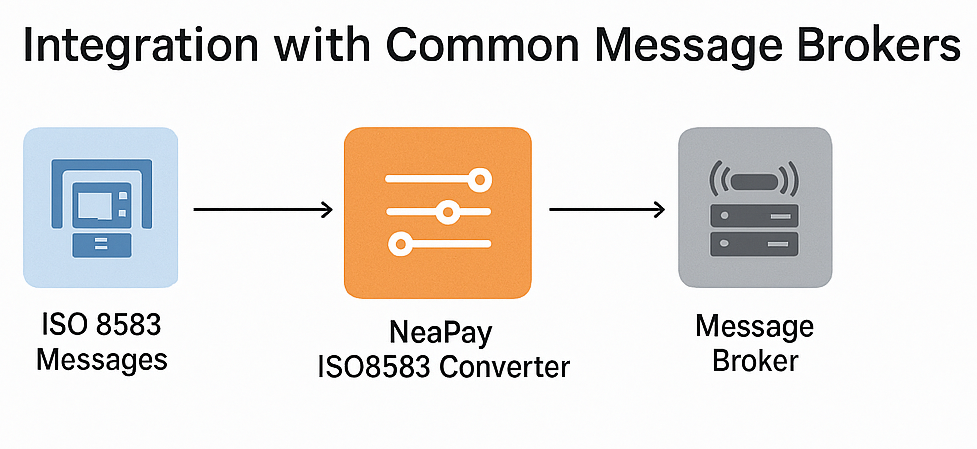
A pre-built ISO8583 converter does not just speed up the integration. It changes which parts of the timeline exist at all.
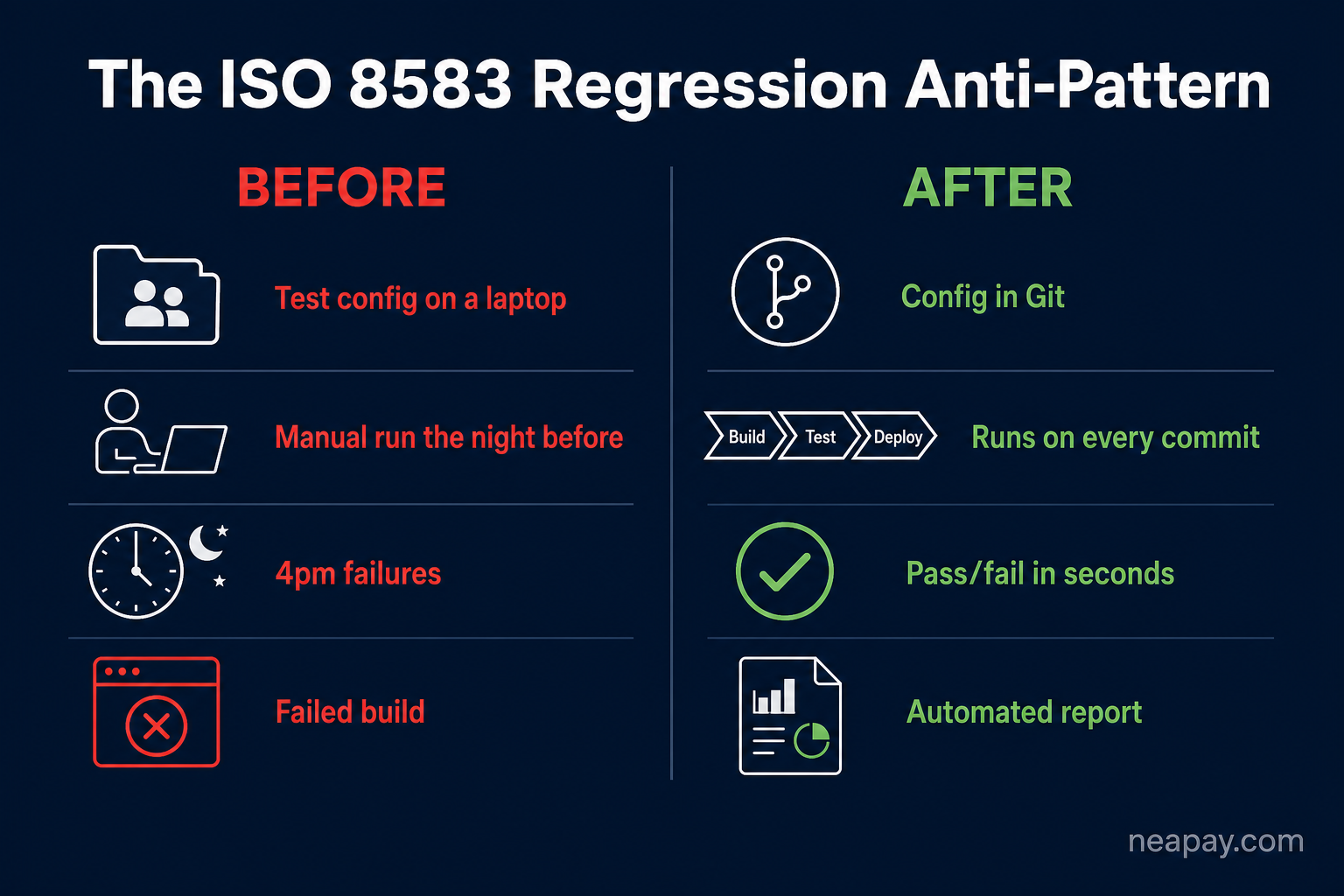
The protocol learning phase disappears. Your team does not need to understand ISO8583 to integrate against a REST interface. The field mapping, bitmap logic, and message encoding are handled inside the converter. Your engineers learn the converter's JSON interface, which is documented in plain terms and has a bounded, comprehensible set of fields.
The connection management phase disappears. The converter handles TCP connection establishment, echo messages, reconnection logic, and message correlation. None of that code needs to be written or tested.
The host clarification cycle shrinks dramatically. Because the converter ships with pre-built profiles for common scheme variants, many of the ambiguities that generate support tickets with your host have already been resolved during the converter's own development and testing. The questions your team needs to answer are about your business data, not about the protocol.
Certification preparation accelerates. The neaPay simulator lets your team run the full set of required certification test cases against a simulated host before connecting to the scheme's certification environment. Issues get caught and fixed in your own environment, on your own schedule, rather than in the certification queue where every failure costs weeks.
The result is a realistic integration timeline of two to four weeks for a team using a converter, compared to four to nine months for a team building from scratch. The delta is not an exaggeration or a marketing claim — it is a direct consequence of removing the phases that consume the most time.
The Conversation Worth Having Before the Project Starts
Before your team commits to an ISO8583 integration timeline, there is one question worth asking explicitly: how many of us have shipped an ISO8583 integration to production before?
If the answer is none, the estimate your team produces — however carefully reasoned — is based on analogy, not experience. It will be wrong in the direction of optimism, and the cost of that optimism will be paid in delayed product launches, diverted engineering capacity, and the compounding frustration of a project that keeps taking longer than the revised plan.
The alternative is not to doubt your engineering team. It is to give them a starting point that does not require them to rediscover four decades of payment protocol complexity on your deadline.
Wondering what your ISO8583 integration would actually take? neaPay engineers will give you an honest timeline assessment based on your specific scheme, host, and message type requirements — no project plan inflation, no optimistic assumptions. Reach out for a technical conversation before you commit to a schedule.