Why the ISO8583 Simulator Is the First Tool Every Payments Architect Should Deploy
Category: ISO8583 Simulator Target reader: CTO, Tech Architect, Payments Consultant Keywords: ISO8583 simulator first step, payment testing simulator, ISO8583 certification testing tool, card scheme simulator, payment integration test environment
Every payment integration project has a moment that experienced payments architects dread and first-timers do not see coming. It happens somewhere between "the code looks correct" and "we need to test against the real scheme environment." The team has implemented the ISO8583 message construction, the TCP connection management, the field mappings. Everything compiles. The unit tests pass. And then the question arrives: how do we actually test this?
The answer, for teams without a simulator, is one of two bad options. The first is to test against the scheme's sandbox or certification environment — which requires credentials that take weeks to obtain, has limited availability, produces opaque error responses that take days to get clarified through support tickets, and cannot be used for performance testing or edge case exploration without risking access. The second is to go directly to production testing with real transactions — which is not testing at all, it is hoping.
Neither option is a real test environment. Neither gives the team the feedback loop they need to develop, debug, and validate a payment integration with the speed and confidence that the project timeline requires.
The ISO8583 simulator is what fills that gap. And the teams that deploy it first — before writing integration code, before requesting scheme credentials, before opening a single support ticket with an acquirer — consistently deliver payment integrations faster, with fewer certification failures, and with less production risk than teams that treat the simulator as a late-stage validation tool.
This article explains why the simulator should be the first infrastructure deployed in any payment integration project, what it provides that no other tool can, and what the difference looks like in practice between projects that use it from day one and projects that reach for it too late.
The Feedback Loop Problem at the Heart of Payment Integration
Software development is productive when the feedback loop is fast. You write code, you run it, you see what happens, you adjust. The faster that cycle runs, the faster you can find problems, fix them, and move toward a working system.
Payment integration development has a feedback loop problem that is structural rather than incidental. The systems your integration needs to talk to — card schemes, acquiring hosts, payment networks — are not yours. You do not control their availability. You do not control their test data. You do not control the error messages they return when something goes wrong. You do not control the response time of the support teams that can clarify those error messages. You cannot run them locally. You cannot restart them when they behave unexpectedly. You cannot configure them to exercise specific edge cases.
This dependency on external systems does not just slow down development — it changes the nature of the development process. Instead of a tight iteration cycle where a problem is identified and resolved in hours, the cycle becomes: implement, submit to external system, receive opaque error, open support ticket, wait days for response, implement fix, resubmit, repeat. A development process that should take weeks stretches into months, not because the engineers are slow but because the feedback loop is broken.
The ISO8583 simulator repairs the feedback loop. It is a system you control, running in your environment, available whenever you need it, configurable to exercise the scenarios you want to test, and capable of returning detailed diagnostic information when something goes wrong. It makes the external dependency internal, at least for the purposes of development and pre-certification testing, and restores the tight iteration cycle that productive software development requires.
What an ISO8583 Simulator Actually Is
An ISO8583 simulator is a software component that presents one or more ISO8583 interfaces — typically a TCP listener accepting ISO8583 messages — and responds to incoming messages with configurable responses that simulate the behavior of a real card scheme host or acquiring host.
At its simplest, a simulator receives an authorization request (ISO8583 message type 0100), validates the message structure, and returns an authorization response (message type 0110) with a configured response code — approved, declined, referral, or any of the dozens of other response codes a real host might return. At its most capable, a simulator implements the full message flow of a card scheme: not just authorization but also reversal handling, network management messages, echo message responses, partial approval logic, timeout simulation, and the scheme-specific message type variants that a certification test case library requires.
The neaPay ISO8583 Simulator is in the latter category. It is not a stub that returns a hardcoded response to any message it receives. It is a configurable simulation environment that:
Validates inbound messages against defined field specifications, returning appropriate error responses for messages that violate field length, encoding, or presence requirements — exactly as a real host would.
Responds to different card numbers with different configured behaviors: approved, declined with specific response codes, referred, timed out, partially approved, or any other response scenario that needs to be tested.
Implements the full ISO8583 message lifecycle including network management messages and echo message handling, so the connection management layer of the integration under test exercises the same behavior it will encounter against a real host.
Simulates failure conditions — connection drops, response timeouts, malformed responses — that cannot be reliably produced by real scheme test environments but that the integration must handle correctly.
Supports the specific ISO8583 dialect variants — HISO87, HISO93, standard ISO8583:1987, ISO8583:1993, and custom field definitions — that different schemes and acquirers use, so the simulation matches the actual target environment rather than a generic ISO8583 implementation.
Logs every message exchange with full field-level detail, providing the diagnostic information needed to understand exactly what was sent, what was received, and where any discrepancy between expected and actual behavior occurs.
This combination of capabilities — dialect accuracy, scenario configurability, failure simulation, and diagnostic logging — is what makes the simulator useful not just for basic connectivity testing but for the full range of development, debugging, and certification preparation activities that a payment integration project requires.
The First Deployment: Why Day One Matters
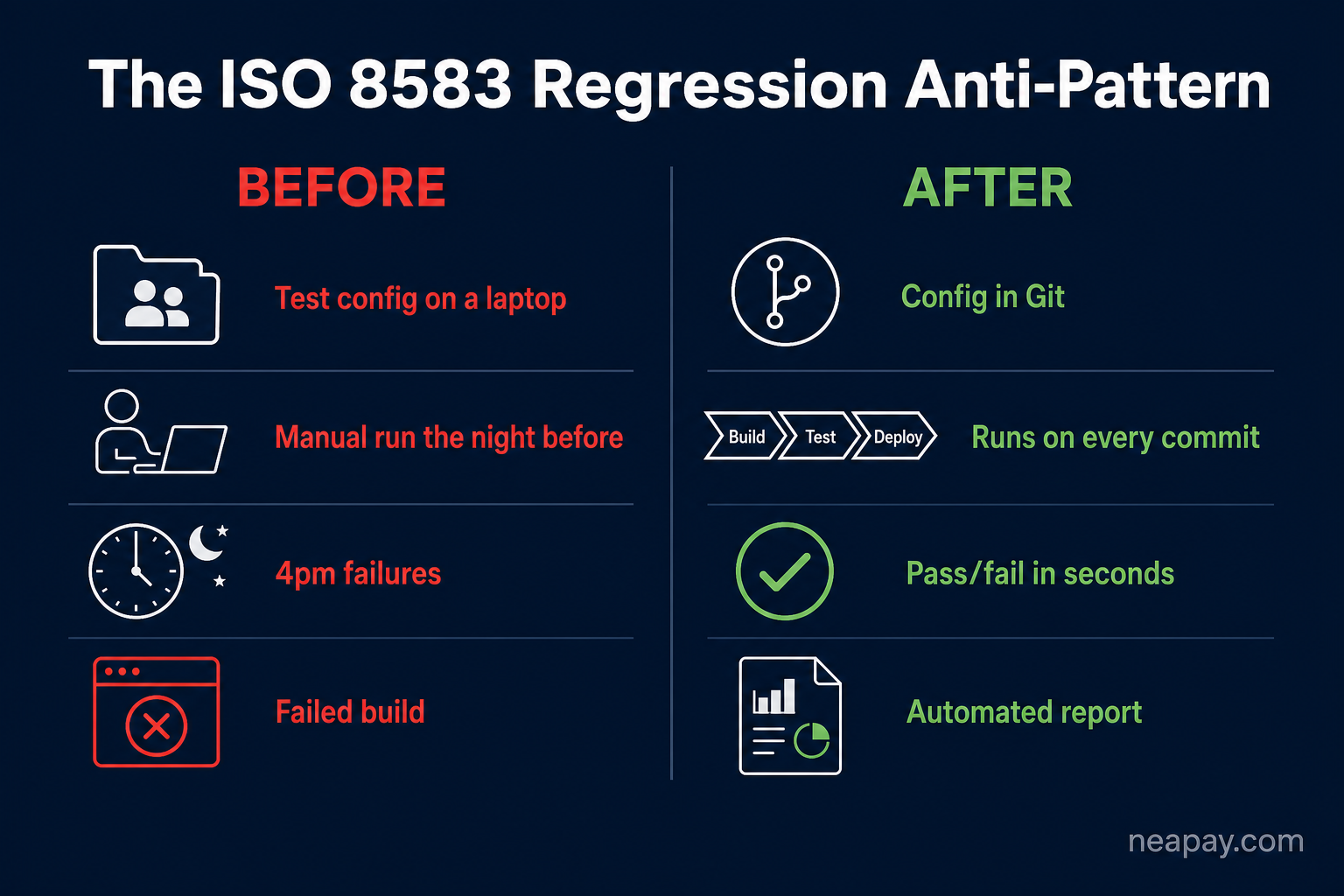
The conventional approach to simulator deployment treats it as a testing tool that becomes relevant after the integration is substantially built. The team implements the ISO8583 message construction, builds the connection management layer, maps the fields, and then deploys the simulator to validate what they have built before submitting it to the real scheme environment.
This approach is not wrong — using the simulator for pre-certification validation is valuable at any point. But it captures only a fraction of the simulator's value, because it misses the development phase where the feedback loop problem is most acute and most costly.
The better approach is to deploy the simulator before writing the first line of integration code. The simulator becomes the target environment for all development work: connection management code is tested against the simulator from the first connection attempt, field mapping is validated against the simulator's field validation responses from the first message construction attempt, message flow logic is tested against the simulator's configurable response scenarios from the first end-to-end test. The real scheme environment is never used for development — only for formal certification, after the integration has already been validated against the simulator.
This approach changes the development experience fundamentally. Problems are found immediately, in your own environment, with full diagnostic information available. A bitmap that is constructed incorrectly produces a field validation error from the simulator with the exact field number and encoding issue identified. A connection management implementation that does not handle echo messages correctly produces a connection health event from the simulator that identifies the specific failure. A reversal flow that is implemented incorrectly produces a response from the simulator that shows exactly how the real host would respond to the same message.
None of these problems would be visible until much later in the conventional approach — some not until certification testing, where discovering and fixing them adds weeks to the project timeline for every issue found. In the day-one simulator approach, they are found and fixed during development, when fixing them costs hours rather than weeks.
The Certification Preparation Case
Even for teams that do not adopt the day-one approach, the simulator's most clearly quantifiable value is in certification preparation. Card scheme certifications require passing a defined set of test cases that cover the full range of transaction scenarios the integration must handle correctly. The test cases are not a surprise — the scheme provides a test case library in advance — but preparing for them against the real certification environment is inefficient in ways that the simulator directly addresses.
Certification environment availability is limited. Scheme certification environments are shared resources with defined availability windows. Your team cannot run certification test cases at 10pm when a debugging session runs late, or on a Sunday morning when an engineer wants to validate a fix before the Monday certification session. The simulator is available whenever your team needs it.
Certification environment error responses are opaque. When a message fails a certification test case against the real environment, the error response is often a rejection code without detailed diagnostic information about why the message was rejected. Understanding the rejection requires either domain knowledge your team may not have or a support ticket that takes days to resolve. The simulator's detailed field-level logging shows exactly why a message failed validation — which field, which encoding rule, which presence requirement — without requiring a support ticket.
Certification environment failures are expensive. A certification session that produces failures requires remediation before the next session can be scheduled. If the certification process has defined session slots — which many scheme certification processes do — a failed session costs not just the time to fix the issue but the time to schedule and wait for the next session. A team that enters certification with ten undetected issues will experience ten failure-remediation-reschedule cycles. A team that used the simulator to find and fix those ten issues before entering certification will pass in the first or second session.
The economics of simulator-based certification preparation are straightforward. The simulator costs a fraction of the engineering time that even one failed certification cycle costs. Every issue caught in the simulator is an issue that does not become a certification failure. Every certification failure avoided is a certification session saved. Every certification session saved is weeks off the project timeline.
For a team with no prior ISO8583 certification experience — which is most teams encountering their first payment integration project — the simulator effectively transfers the certification learning curve from the certification process itself to the simulator environment, where the cost of that learning is engineering time in your own environment rather than delayed project timeline and external queue dependencies.
Scenarios the Real Environment Cannot Give You
There is a category of test scenarios that the simulator provides which no real scheme environment can reliably produce: controlled failure conditions. These are the scenarios that reveal whether the integration handles adverse conditions correctly — and they are exactly the scenarios most likely to cause production incidents if they are not tested before go-live.
Response timeouts. A real scheme environment processes messages within its normal response time. It does not, as a testing service, deliberately hold responses for thirty seconds to test whether the integration's timeout handling triggers correctly. The simulator can be configured to delay a response by any duration — or to not respond at all — so the integration's timeout detection, reversal initiation, and failover logic can be tested under controlled conditions.
Connection drops. A real scheme environment maintains its connection reliably. It does not, as a testing service, abruptly close the TCP connection mid-session to test whether the integration's reconnection logic works correctly. The simulator can be configured to drop the connection at any point — after a defined number of messages, at a specific time, in response to a specific message type — so the integration's connection management resilience can be validated.
Malformed responses. A real scheme environment returns well-formed messages. It does not, as a testing service, send a response with an incorrect bitmap or a field encoding error to test whether the integration handles receiving a bad message without crashing. The simulator can be configured to return malformed responses so the integration's inbound message validation and error handling can be tested.
Partial approvals. Some schemes support partial approvals — where the authorized amount is less than the requested amount — but producing a partial approval reliably in a scheme test environment requires specific test card data that may not be available or may produce inconsistent results. The simulator can be configured to return a partial approval for any specified card number or amount range, making partial approval handling testable on demand.
Specific response code sequences. Real scheme environments return response codes based on the test card data submitted. Producing a specific response code sequence — approved followed by a reversal timeout, or declined followed by a retry that is approved — requires specific test card data and specific message sequencing that can be difficult to reliably reproduce. The simulator's scenario configuration allows any response code sequence to be defined for any card number, making complex multi-message scenario testing deterministic and repeatable.
These controlled failure scenarios are not edge cases that rarely matter in production. They are the scenarios that define whether the integration is production-reliable or production-fragile. An integration that has only been tested against a cooperating scheme environment that always responds correctly and always maintains its connection will encounter these scenarios in production — because production networks are imperfect, production hosts have their own failure modes, and production traffic volumes stress connections in ways that test environments do not. Testing against controlled failure scenarios in the simulator before go-live is the difference between discovering these issues in a controlled test environment and discovering them in production at peak transaction volume.
Performance Testing: The Capability No Real Environment Provides
Card scheme certification environments are not performance test environments. Submitting high-volume transaction traffic to a scheme certification environment is a violation of the acceptable use terms for that environment, and attempting to do so would likely result in revoked credentials. The scheme's certification environment is a functional test resource, not a load test resource.
This means that teams using only real scheme environments have no way to validate that their integration performs correctly at production transaction volumes before going live. They do not know whether the connection management layer handles concurrent messages correctly at 100 TPS. They do not know whether the routing engine's rule evaluation introduces latency that becomes significant at peak volume. They do not know whether the transaction logging creates write contention under load. They discover these things in production, when fixing them requires a production incident response rather than a controlled engineering fix.
The neaPay ISO8583 Simulator supports performance testing as a distinct usage mode. It can be configured to respond to messages at the speed of a real host — including configurable response latency that matches the expected acquirer response time — while accepting the transaction volume that your integration generates during a load test. Your integration can be subjected to 500 TPS against the simulator, the response times can be measured, the error rates can be analyzed, and the system behavior under load can be characterized — all before a single production transaction is processed.
Performance testing against the simulator does not replicate every aspect of production performance. The network path to the simulator is different from the network path to a real acquirer. The simulator's internal processing characteristics are different from those of a real host. But performance testing against the simulator does reveal the integration-side bottlenecks — connection pool contention, routing engine latency, logging write throughput — that are entirely within your control and that must be addressed before go-live regardless of what the real host's performance characteristics are.
The Simulator as a Permanent Part of Your Test Infrastructure
Teams that deploy the simulator for a single integration project sometimes treat it as a temporary tool: useful for this project, retired once the integration is live. This underestimates the simulator's long-term value as a permanent component of the test infrastructure.
Regression testing. Every time the integration is modified — a new message type added, a routing rule changed, a field mapping updated — the simulator provides an environment for regression testing the full integration behavior before the change is deployed to production. Running the certification test case suite against the simulator after every significant change validates that the change has not broken existing message flows, without requiring access to the scheme's certification environment.
New team member onboarding. A new engineer joining the payments team can use the simulator to understand the message flows, experiment with message construction, and develop intuition about the protocol without needing credentials for a real scheme environment. The simulator is a safe learning environment where mistakes produce diagnostic error messages rather than failed transactions or revoked certification credentials.
Incident debugging. When a production incident involves incorrect message handling — a field encoding issue, an unexpected response code, a message flow that does not match the expected behavior — the simulator can be used to reproduce the specific message sequence that triggered the incident, in a controlled environment, to understand the root cause and validate the fix before deploying it to production.
New scheme onboarding. When a new card scheme or acquirer is added to the routing configuration, the simulator provides an environment for validating the new dialect profile and the new routing rules before connecting to the new acquirer's test environment. The same certification preparation workflow that was used for the first acquirer applies to each subsequent one, with the simulator as the primary pre-certification test environment.
The simulator's value compounds over the lifetime of the payment infrastructure. Each new integration project, each routing change, each new scheme adds to the regression test suite that the simulator supports. The investment in the simulator — deployment, configuration, integration into the development workflow — pays dividends not just on the first project but on every subsequent change to the payment infrastructure.
The First Tool, Not the Last
The insight that experienced payments architects carry and first-timers learn the hard way is that the simulator is not a validation tool for a nearly-finished integration. It is a development environment for the integration from its first day.
Deploying the simulator first — before writing connection management code, before requesting scheme credentials, before mapping fields — sets the development process up with a feedback loop that functions. Problems are found in your environment, with your tooling, on your schedule, with full diagnostic information available. The scheme's certification environment is used for what it is designed for: formal certification of an integration that has already been thoroughly validated. It is not used as a development sandbox, because it is a poor development sandbox.
The teams that deliver payment integrations on time and with minimal certification failures are not the teams with the most ISO8583 expertise on staff. They are the teams that structured their development process correctly — with a simulator that gives them a real feedback loop, a controlled test environment for failure scenarios, and a pre-certification validation suite that finds issues before they become certification failures. The simulator is what makes that structure possible, and it is the first thing those teams deploy.
Ready to set up your payment integration development environment before writing the first line of protocol code? The neaPay ISO8583 Simulator can be deployed in your environment — on-premise or cloud — with dialect profiles pre-configured for the most common scheme variants. neaPay engineers can help you define the scenario configuration that covers your specific certification test case requirements from day one. Reach out before your integration project starts, not after the first certification failure.